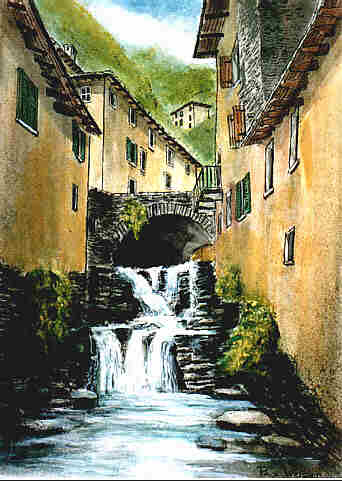
Sunday, November 06, 2011

Domo A Como


It seems an age ago now that my wife and I holidayed in Argegno, a friendly and colourful village on the shores of Lake Como. A little over a year, as it happens. I wrote a blog post about the holiday, full of glowing praise for the scenery, the serene and stress-free days on the lake and the people – most notably the wonderful staff at the Hotel Argegno where we often dined and our brilliant and thoroughly entertaining host, Paul Wright, at whose B&B we stayed.

Unfortunately, my netbook went and died and took – amongst other things – that blog post with it. Luckily then, along comes this opportunity to revisit those memories and in the company of a terrific storyteller.

Of course, in staying with artist and author, Paul, we were spoilt, treated to huge helpings of local tales, at least as colourful as the setting, all washed down with plenty of dry wit wine.

In Paul’s book, An Italian Home, the authorial voice is, inevitably, an edited version of the man himself and that’s a shame, but to be fair it’s a bit like that common niggle we all make, that we perhaps enjoyed a movie but it wasn’t as good as the book. At the end of the day, if you haven’t read the book, then that’s not going to be a factor and besides they’re two distinct art forms, aren’t they, so they’re bound to be different.

So while there are some stories and turns of phrase that didn’t make it into print, Paul still writes an engaging account of his and his wife’s uprooting and relocating to in Italy. The small, friendly village of Moltrasio – rather than Argegno, where they now live – provides the main focus for the story, as Paul and Nicola do battle with the horrors of Italian bureaucracy, come up against unexpected cultural differences and struggle with the language barrier in their quest to hold on to their dream of a new life.


To be fair, it’s mostly Paul who has the struggles with Italian and he’s refreshingly blunt and honest when it comes to admitting his reticence and stubbornness as a language student. There’s none of the illusory effects of Paul’s trompe l’oeil paintings; he tells it like it is and while the world of Lago di Como is, take it from me, paradise – albeit with too much traffic – he gives a very clear picture of the daunting aspects of their adventure, right alongside all the warmth and enchantment that made the two so determined to overcome those hurdles.

The book breezes from chapter to chapter – interest only flagging (for me and my wife) when it explores some of the idiosyncrasies of Italian football, but that’s just our personal anti-football bias and it’s true to say that Paul’s own passion for the sport clearly shines through in the writing. And among the comic episodes (that we had the pleasure of hearing live) that did make it into print are the story of Paul and Nicola’s encounter with the local police chief, Signor Pompino, and poor Nicola’s faux pas (or whatever Italian for faux pas might be) when waxing freely about sticky fig juice in among some of her and Paul’s Italian friends. You will likely feel her embarrassment while laughing at the same time.

Although by no means a tourist’s guidebook, well worth a read, even if you’re only planning a holiday in the region. Guidebooks give you facts, while stories like this give you flavour. And if you’re entertaining similar dreams of relocation, well, you’d do well to read about Paul’s and Nicola’s shared dream, entertainingly told.

Dreams may not always come true, but with a measure of courage, determination and hard work, you can make them.

An Italian Home is available on Amazon, price £8.09.


You can also check out some of his artwork - and find out about his B&B - on his website.


SAF

Saturday, October 15, 2011

Chucks Away

Continuing our irregular review catch-up, a few words on Chuck...


When I first discovered Chuck I thought of it as something like Alias, but fun. Now that it’s reached the end of its fourth season and is on the verge of its fifth, that comparison holds true, albeit with a shift of emphasis. I.e. it’s more like Alias, with increasingly convoluted made-up-as-they-go-along storylines, and not quite as much fun. The characters, the colour, the charm and the humour are all still there in the mix, and there’s plenty of its own-brand warm-hearted action, intrigue and spy-jinks with geekdom and electronic retail on the side... but the show has started to feel tired, with a few too many treadmill episodes in between the highlights.

It’s like your favourite six-inch sub that's been around for too long – has all the same great ingredients you love – but it’s gone a bit stale. This is, I guess, only to be expected when you muck the chefs about.

Because Chuck’s future has been firmly in doubt since series two, saved by a Subway product-placement deal, but only ever handed temporary stays of execution – 13 episodes here, another 9 episodes there, and so on. Frankly, it must be a nightmare having to work to that kind of stop-start framework, when they’re endeavouring to construct more than standalone episodes. And in defence of the writers and production team one thing they have actually been consistently great at is working towards a succession of potential series finales. Whenever interest has begun to wane, my attention has been grabbed again in the run-up to the key 13th and 22nd or 23rd episodes every time.

Somehow they manage to wheel in the crash cart and shock new life into proceedings at around the same points in the series every year. But against that, they’ve demonstrated a persistent reticence to shake things up or play too adventurously with their formula. And if you don’t play with the dynamic from time to time, your show will lose some of its dynamism.

On the other hand some shows may be like replicants and have a built-in limited lifespan by virtue of their format or central premise.

Chuck’s premise is a nifty little one. Nerd becomes hero thanks to a huge supercomputer downloaded into his brain. Totally far-fetched, of course - a computer system requiring no daily updates? - but from the get-go suspension of disbelief was not a problem, courtesy of the tone in which it was all delivered. Not just in the tongue-in-cheek department, but as I say, it brimmed with warmth and charisma. And in amongst all the nerdish humour and spydom, it forged unlikely bonds (unlikely Bonds?) into credible, touching human relationships. It had heart.

And even when the product placement came along it was cheekily blatant and embraced as a running gag. Which, if you really have to embed advertising in your entertainment, I guess is the way to go about it.

It also boasted a brilliant ensemble cast of characters. From the wonderfully gruff uber-Republican, gun-loving John Casey (Adam Baldwin), to the kooky sleazemeisters of Jeff and Lester (to say nothing of Jefster). Big Mike in charge of the Buy More. Ellie (the lovely Sarah Lancaster, who would've made a great Wonder Woman) and Awesome (the hilarious Ryan McPartlin, who would've made a great Captain America), Chuck (Zachary Levi)’s devoted (and gorgeous) sister and his (awesome) brother-in-law. Morgan (Joshua Gomez), Chuck’s even more nerdish sidekick. And of course, Sarah Walker (the inconceivably gorgeous Yvonne Strahovski), Beauty to Chuck’s Geek.

They even added to this from time to time with extended family – parents of some of these characters – every one of them an absolute gem of perfect casting and every dad a starship captain: Scott Bakula, Bruce Boxleitner and Gary Cole. The inclusion of Chuck’s dad, as the mysterious Orion, makes for an especially well-woven and involving story arc and – particularly in the context of what can often be a very cosy series – his ultimate fate is a genuine shock.

Where matters begin to gang aglay, for my money, is when they bring in Chuck’s mum. Although brilliantly cast again, in the shape of Linda Hamilton (and maintaining that principle of hiring from the kind of cult-SF stable that will have that added appeal for nerds everywhere), it’s not so much that they introduce the character as part of an arc, it’s that they then fail to do anything really different with it. There’s a whole is-she-bad, is-she-good question that they run with for a while, but the answer is ultimately that of course she did everything for the best reasons and has Chuck’s (and Ellie’s) interests at heart. Just like his dad. And that is ‘nice’, but boring. Oh how much more fascinating it might have been if she’d turned out to be a bitch.

Other plot opportunities are similarly blown later on down the road, with a clear chance for Ellie (and perhaps even Awesome as well) to be zapped full of the Intersect. Or even their baby - for god’s sake, anything that might have shaken up the status quo and got the show playing something other than the same three chords. Of course, it’s also often true that a hero is only ever as good as the villain he’s up against, and they’ve fielded a reasonably successful bunch of baddies through the various (but not too varied) story arcs, culminating in Timothy Dalton putting in an exceptional star-turn as the ‘misunderstood’ Volkoff. Replacing him with his daughter has yet to properly pay off – the female of the species is supposed to be deadlier, but Lauren Cohen has yet to fully convince.

Meanwhile, the Chuck family has possibly grown too large and a number of the previously terrific characters have had to take turns in being sidelined – Ellie and Awesome frequently, and even John Casey on occasion. Which is borderline criminal. It’s at least in part owing to the decision to reinvent Chuck as a bona fide superhero, rendering his special agent backup somewhat superfluous. And the small ways in which the producers did attempt to play with the format – like having Morgan follow in Chuck’s spy footsteps – haven’t really worked.

Now I gather that the makers have decided this (fifth) will be the last season and whereas earlier (premature) reports of its demise were met with a loud “Oh no!”, I greet this news with a bit of a “Phew” to be honest. Because finally the writers and producers get to work towards an end that is under their control and I can hope that at least they wrap things up spectacularly and satisfactorily. (Especially after the series four finale! Eek!)

At the end of the day, although there has been definite flagging, I do care about the characters and they deserve a proper bow at curtain close. I hope that the writers will use these final episodes to be brave and bold and pull off a few big surprises to make up for the missed opportunities of the past two seasons and, above all, not just throw them away. Go out with a bang and not with a whimper. In short, go out in style.


Because while I (wholeheartedly) appreciate the principle of having Yvonne Strahovski (pictured above) dress up in different outfits each week like a sort of sexy Mr Benn, I don’t believe you can build a forty-plus minute show around it (although by all means send me the rushes and I'll reappraise its viability) and ideally there has to be something more to command audience attention week after week.

So to finish off this particular TV dinner, I’ll settle for a 13-episode sub, as long as it’s fresh.

SAF

Thursday, October 13, 2011

Destiny's Child

Q: What do Amelia Lily and the other contestants summarily dumped from The X Factor last Sunday have in common? A: Absolutely sod all. (Heck, I'm not gonna even mention their names in the same blog post.) And I honestly trust that music industry execs recognise that.


According to news reports in the aftermath of the show, Amelia herself has described the 'surprise twist' as unfair (true and then some) but doesn't hold any grudge against her mentor, judge Kelly Rowland (gracious and yet more evidence of this talented young girl's maturity).

My own take? Well, for what it's worth, I felt that soul sister Kelly didn't have too big a clue as to what to do with a talented 'rock-chick' like Amelia, hence the unnecessary re-branding with the pink hair and giving her a rocked-up version of a Jacko song to perform on Saturday's live show. For my money, a poor choice of song, for all that Amelia then went on and aced it in spite of the 'unsuitability' factor. Seriously seriously good and if she hadn't been announced as a contestant, you couldn't have told her from some of the professional guest acts they have on the Sunday results shows. Come to that, she was *better* than a lot of the guest stars.

But that's part of the problem with The X Factor, in any case, isn't it? This week-by-week urge to hammer contestants into roles and songs where they don't fit. Fact is, there was no need to mould Amelia Lily. She struck me as an original from the get-go, a genuine talent.

At her audition, judge Tulisa was bowled over and told the (about to turn seventeen, then sixteen-year-old) girl, there were people in the business who'd been at their trade for years and still weren't at the level she, Amelia, had reached. (Never mind that in Saturday's show, Tulisa then attested that she hadn't really seen Amelia as a contender until her opening performance - er, a little less hippo in your crit there, Tulisa.) Also, back at the audition stage, Kelly and Gary were appropriately awed and Louis was heard to declare "A star is born." Well, yes and no. This star was born sixteen years previously - a real natural, gifted and so mature for her age - and was only waiting to be discovered.

In retrospect, it's interesting that the producers chose to play Beyonce's Best Thing I Never Had as a soundtrack to the tail end of that audition segment. Not because she's been denied her X Factor opportunity, but rather that she is, in my opinion, the best thing the show has never had. I do still love lil Janet Devlin and her enchanting vocal style, but Amelia Lily was the competition. There are other kids in there who might be moulded into something, but there's nobody left in there who so obviously had everything the show is always allegedly looking for. I can't think that they've ever had anyone who was so obviously a ready-made star.


All I can say to Amelia is, you're free of the circus and you can go on and write your own material and totally be yourself. Of course, I'm only sorry I miss out on 10-12 more probably stunning performances, but you're clearly so much better than the talent-show level already. Watching and listening to the few videos Amelia has posted on YouTube (see just one example, above), that much is patently obvious and a poor webcam mic in the bedroom is completely inadequate to show off her vocal talent.

And I hope Kelly Rowland's sincere about her offers of support. Because now that the Destiny's Child singer has seen fit to send her star home, I think the least she could do is open a few studio doors for her. And on the plus side I hope this might mean we get an Amelia Lily debut album all the sooner.

This girl's destined for great things.

SAF

Saturday, October 08, 2011

Quel Dommage!

Here in the gulf between Doctor Who seasons, it's customary to review 'other stuff' and as it turns out we have a few things in the experiential archive to catch up on... First up, a spot of crime impassionale.

Some things are doomed by their advance press. I mean, how often has your entertainment appetite been whetted, your expectations been built up by a trailer? Pretty frequently, I would guess, since that’s the trailer’s job. And then there’s word of mouth, which is allegedly the best form of advertising. Any form of advertising is only good though if the product lives up to the hype, while if it doesn’t, well, the product itself will suffer in the comparison.


Poor Engrenages (aka Spiral). It never stood a chance.

No trailers came my way for this, but I’d heard excellent things about it. Not least of which was – courtesy of a friend – that it was like the French cousin of The Wire.

In fact, it bears such little relation it seems like one of those long lost relatives who only show up out of the woodwork hoping for a share of the inheritance. For one, there’s none of the complexity or social layering of the American show, albeit that there is a political angle to proceedings. Sure, plenty of the characters are fils des plages (sons of beaches) but I can’t think of any who are as brilliant (and even likeable) as so many of The Wire’s lowliest lowlifes. It’s a different bĂȘte altogether. As such, it’s unfair to judge it in those terms, but unfortunately my expectations had already been coloured. And I daresay some of my criticisms will have arisen from that accidental letdown that had nothing to do with the series itself.

So bear in mind through my ramblings, s’il vous plait, that the series is by no means terrible.

It’s well-acted. The direction lends the whole thing a suitably arthouse, suspenseful and occasionally haunting quality and it’s structured to deliver a clever dramatic upper cut at each episode end. It’s probably well-scripted, although my French falls far short of being able to tell that and the subtitles are frequently lifeless and drab. Then there’s episode six or seven where the subtitler fell asleep or something and allowed some painfully clumsy and lazy faux pas to litter the translations.

What it has in spades is grimness. Its depictions of crime scenes and autopsies are uncompromising and never fail to genuinely horrify. As a gritty realistic portrayal of police – and judicial - work in la belle France, it convinces. (For all I know.) While as a drama, for me, it ultimately fell un peu flat.

Trying to be objective and leaving Wire comparisons out of it, the key shortcomings for me lay in the cast of characters. (NB Not the actors, none of whom I could really fault.) The only one I had any empathy for was Laure Berthaud (Caroline Proust), the female detective heading up the various investigations. The chief prosecutor (Gregory Fitoussi) is a big wet blanket, far too easily manipulated by his wife and his parasitic pal Benoit (Guillaume Cramoisan). Both of whom, by the way, whinge and complain about their lot, despite the fact that they each got themselves into their respective messes. And here a measure of contrast with The Wire is called for, because these French criminals are the socially privileged sort, far far removed from the disadvantaged, disenfranchised communities of Baltimore. So hearing them moan when their hands are caught in the metaphorical cookie jar is a test of patience.

There’s a washed-up junkie detective (Thierry Godard) who I think we’re meant to sympathise with, but he has none of Jimmy McNulty’s redeeming charm. And a number of characters spend time being enigmatic and impenetrable for no other reason I can fathom than they’re in a French production – like the bitch lawyer who buries evidence of a man’s false rape conviction because, er, well I guess because she’s a bitch. Possibly there were some subtleties there I missed, but they’re easily missable when there’s no emotional connection to the characters. There’s an aloofness and a distance to almost everyone - apart from the victims, who are, alas, generally encountered on a mortuary slab or mutilated and dumped on some patch of the city’s wasteland.

Storywise, while the tone is definitely one of mystery, the actuality is somewhat lacking and left me strangely unsatisfied. As initially compelling as the central case was, all leads appear to dry up shortly after the victim’s diary is appropriated by the criminals and the investigation largely dead-ends (or cul-de-sacs), until it’s left to bleating Benoit to fess up and the fate of the poor girl with her face bashed in is finally revealed to us in flashback. Rendering the whole thing a lot less spirally and less complex than it would have you believe.

We end, inevitably and perhaps predictably, on a shot of another unidentifiable corpse as a lead-in to the second series. But I can’t decide whether it’s promising better or more of the same.

At the very least, now knowing what to expect, a second series will stand a good chance of being judged entirely on its own merits. So I may be persuaded to give it that opportunity.

Until then, I can't be sure how much of my sense of dissatisfaction is down to comparison and how much is down to a simple matter of taste.

C'est la view.

SAF

Tuesday, October 04, 2011

X Factory

No Doctor Who next weekend, boo hoo, so perhaps a good time to look at another source of Saturday night popular entertainment...

And it’s that time of year again when the workers have clocked in, the products are all lined up on the production line and the rest of the music industry hangs its head and/or probably wishes it had come up with the idea before Simon Cowell.

People knock The X Factor. And justifiably so. It’s a circus. Complete with performing animals, although some of them prefer the title ‘judge’.

Louis the Leprechaun chuckles all the way to the bank to collect his pot of gold every year, surely with no actual aims or hopes of ever seeing one of his category emerge as a winner. He’s the one who’s consistently seen pushing through the joke acts and the sub-Eurovision wannabes. Seen, because I’ve every confidence there are those at work behind the scenes nudging the clowns and contentious as far through the competition as they can to generate the appropriate level of ratings and tabloid coverage.

But the show is a guilty pleasure for many, myself included. Originally I think I ended up watching it in a fit of Saturday night boredom some years ago and finding myself entertained by the long line of execrable early auditions. A lot of vocal Verbal Kints in a row of Unusual Suspects. And not a single Keyser Soze among them, but some just as scary all the same. But then what would happen a number of years would be that a handful of actually pretty good singers would show up in the mix and you’d end up supporting them through to the live shows. Might be down to my imagination or my tastes, but it seems to me that’s happened more often latterly.

And on those (admittedly rare) occasions when you come across a real star in the making, it’s scarcely a guilty pleasure at all. Just an unashamed treat.

Those who mock and state that true talents are never discovered in this way demonstrate a limited grasp on reality. You might as well say that true writing talent is never discovered through hard graft, countless submissions and pure dumb luck of landing on the right editor’s desk at the right time. Come to that, I’m currently prepping a submission for a writing competition; the only thing that prevents it from being such a circus is that it’s not being televised. And, after all, who would stick a writing competition on the TV? (Trust me, this stage is not very exciting – essentially a lot of tapping at keyboards, procrastination, banging heads on desks and frequent frustration with the standard of prose.)

Heck, it’s impossible for me not to relate to some of these young hopefuls, chasing their life’s dream. Been there - still chasing and still, if not young, then not exactly grown up. Comic asides aside though, there’s a great deal for aspiring authors to empathise with and even to envy. Would that we had that kind of platform, eh, to publicise our talents. HarperCollins’ authonomy site was a step in that direction and, in its own way, as much a circus, but let’s face facts, it could never command the same ratings.

In terms of music competitions, well, I do believe there’s room for one. (Because The X Factor isn’t that.) Indeed, I’m surprised the Beeb hasn’t shown a little more creativity – hmm, what am I saying, this is the channel that brought us Don’t Scare The Hare and Epic Win – in launching a rival reality show that focuses on bands (you know, actual bands, with instruments, not groups of boys or girls lining up for a go at the autotuner) instead of promoting another singing comp in the form of The Voice.

Still, never mind that, this is the 21st century – sorry, all those lute-strumming Luddites out there – and if you’re not using YouTube, Facebook, Twitter and all the rest to raise your profile, then you’re doing yourself out of an audience. Likewise, as long as ITV are providing the opportunity, then singers might as well avail themselves of the chance for some proper wide-reaching media exposure. These days, you can even fall at a relatively premature hurdle and still get noticed or even signed up for an album contract.

It’s not for everybody, sure. And while that stigma remains attached in some people’s eyes, I guess it *could* be as effective a career-killer as a career-launcher. The main risk you run in the pre-live-show stages is getting passed over in favour of one of Louis’ gag acts. Which, I appreciate, would be gutting. But to my mind, I think the only real potential career-killer is that crucial debut album. Followed by, assuming you survive that first one, the even more crucial follow-up album.

It’s not the winning – or the coming second or third etc – it’s what you do with it that counts. Last year, I was a firm supporter of Matt Cardle, Rebecca Ferguson and Cher Lloyd, all of whom have albums on the way. So far, Matt_Cardle’s singles haven’t impressed as much as his songs from his pre-X Factor Seven Summers album, but they’re pleasant enough pop songs that could use a bit more memorability. While Cher Lloyd’s Swagger Jagger is appalling and all too memorable. I detect the hand of Will I Am at work there, buy whoever’s to blame, it’s too easy for producers to funnel these youngsters into something they’re not. Cher Lloyd was a wonderfully spiky sort of peg and, unless there’s better material making up the rest of her album, I fear she’s been hammered into a god-awful square hole.

This year, I’m championing Amelia Lily:


And little Janet Devlin:


Seen above in 'home video' mode. Both 16, both amazing.

The girls were the strongest category by a bazillion miles and although I personally don’t feel they were whittled down to the absolute strongest four (I’d have put lil Melanie McCabe through for sure – and I’d add, to the likes of Melanie, just remember the X Factor is an opportunity, no more, no less – it’s not the be-all and end-all - *nobody* should buy into this horribly pervasive idea that, if they don't make it through, that's it for them, it's all over), they’re the only category with a clear winner (two, in fact) at the outset.

The boys are an odd mix and I’d be hard pushed to tell you their names, although James, I think it is, strikes me as the best of that bunch. Frankie seems like a mini-Robbie and therefore so far from my cup of tea as to be chamomile, which I find (for the record) horrible and not at all calming. The groups are doomed. Poor Tulisa, she started out by impressing me as someone who knew her business, but she has her work cut out for her there. In fairness, she had precious few materials to work with, but she went and broke up the one group that seemed to have something – throwing away The Keys, in favour of cobbling together another group on the spot. And the Over 25s are, apparently, there to pad out the numbers and provide the comedy and controversy. That would have been even more the case had Goldie not turned down her spot on the show and you have to wonder how Sammi feels, being told, sorry it’s such short notice and I know we initially rejected you and all, but our chief gag act couldn’t make it, we’d like you to take her place. This year’s Mary Byrne replaces this year’s Wagner, while – thank heavens – we still have this year’s Katie Waissel, in the shape of uber drama queen Kitty, to divide the nation. Yawn.

But Amelia and Janet, for my money, are genuinely exciting and it doesn’t matter that this is the arena in which they were discovered, they’re authentic talents. X Factor mentor, Kelly Rowland, whatever you do, don’t mess with them too much. (I was a bit concerned with the makeovers that have been inflicted on them for the live shows and just hope it doesn’t too dramatically alter what they are in the minds of the viewing public.) Janet Devlin perhaps needs a teensy bit more work to get her to pop-star status, but only in the confidence department. And even then, when she sings, she’s perfectly at home, her Ellie Goulding/Cranberries-esque, unaffected but wonderfully affecting voice naturally transforming anything she sings to make it very much her own. Amelia Lily, meanwhile: pop star name, pop star image, rock star voice. Such a mature sound for her age, incredible. Ready made star, you might as well just go ahead and record her album now.

Inspirational. Love em both.

If just those two alone are what comes out of the pop-singer factory this year, then that's all the validation this annual process needs.

So, sure, in summary, The X Factor’s rubbish. But it’s nothing worse than a televised slush pile. You have to hope the best of the talent rises to the top. Unlike a slush pile, at the very least, they’re going to get noticed.

Go, Janet! Go Amelia Lily!

SAF

Sunday, October 02, 2011

Married Bliss


Dearly beloved, we are gathered here today, in the sight of blog, to witness The Wedding Of River Song. If anyone here knows just cause or impediment as to why we shouldn’t consider this an entirely fitting and perfect finale to the season, they should speak now or forever hold their peace.

Well, there’s the title, for one thing. I remember back in the golden age when we had ‘Of’ titles, they’d be like Planet Of The Spiders, The Hand Of Fear, Horror Of The Daleks, The Evil Of Doom, The Curse Of Fatal Death, all that sort of thing. Now we get The Wedding Of some woman or other. Honestly, I ask you, where’s the unbridalled terror in that?

But, in the modern TV fashion of overstating the obvious, this is not a serious complaint. There are, yes, a few little gripes here and there and doubtless more will occur when the honeymoon period is over, but in the context of everything it had to achieve, this was as perfect a season finale as you could ask for.

As much as I was entertained by Let’s Kill Hitler, it didn’t feel like a follow-on from the mid-season closer and that’s because it wasn’t. This, but for a few details to join the dots, is the other half of the excellent A Good Man Goes To War.

There’s a huge amount of common ground in tone and its early stages involve something like A Good Man’s planet-hopping vignettes, with the Doctor here, instead of roaming time and space in search of a maginificent alien seven, doing his utmost to track down the Silence. It’s not quite as magical as its precursor, but what can you expect when you don’t have a lactating Sontaran nurse, a lesbian Silurian adventuress and a fat blue man among your guest characters. In their place, you have a couple of strange geezers with eyepatches, a shape-changing robot crewed by little people and, oh yes, a fat blue man’s head. In a box.

Dorium’s return is welcome – even though the poor chap has lost a lot of weight – and the various settings we’re treated to – the ‘live’ chess tourney and the ‘cave of skulls’ – are more evidence of Moffat’s twisted imagination on overdrive.

And of course, it’s all preceded by that fantastically madcap opening set in London, April 22nd 2011, 5:02pm. Where all of history is happening simultaneously, but time is stuck in the same single moment. It’s all utter nonsense, of course, and would take a better temporal physicist than me to analyse, but (I’ve said it before and I’ll say it again) Moffat’s a magician. An illusionist. It’s all sleight of hand and keeping the show moving so, crucially, you’re not generally asking too many questions at the time. You’re more frequently hanging on the next scene, too intrigued by what’s going to happen next.

The only question I recall in my head at the time was “WTF?” But in a good way. In fairness, at the very start, I wondered if I was watching a car ad – there’s one with cars suspended from balloons – but when you’ve thrown in steam trains chuffing out of the Gherkin on viaducts, Do Not Feed The Pterodactyl signs in the park (ha! you think those predators are bad, you should see the seagulls preying on unsuspecting holiday makers in some of our Cornish resorts), Charles Dickens (Simon Callow, yay!) on BBC Breakfast, and Churchill, the Holy Roman Emperor, presiding in Buckingham Palace, you kind of have to just nod, accept the madcapness of it all and say, okay, Steven, you’ve got my attention.

The construction of having the Soothsayer Doctor relate events to Churchill could have slowed things up, but the bouncing between storytelling and past events was skilfully handled and what’s more there’s a wonderful progression in the Churchill scenes where the Doctor’s been making tally marks on his arm. A signal of the Silence’s presence that we should all have remembered from the season opener, The Impossible Astronaut/Day Of The Moon. Deftly done and culminates in that fantastic reveal with the Silence hanging vampire-like from the ceiling.

Followed swiftly by the arrival of Pond, Amelia Pond on the scene. Brilliant, laugh out loud moment, and eyepatch or no Karen Gillan looked, if possible, better than ever. And on a less superficial level, she, like pretty much everyone here, was on top form.

First eyepatch geezer was a bit bland, maybe, and second eyepatch geezer was little more interesting than a Buffy demon-of-the-week cast-off, appearance-wise, but they did their part in adding a touch more colour to the whole Silence mythos. I will say that the shot of eyepatch-demon being consumed in the pit of skulls struck me as dead dodgy. A spot of CGI trickery that wasn’t quite up to the task set by the script. Still, it’s over and done with shortly enough and the jarring effect is fleeting. The captain of the Tesselector is still dull. Sorry, but there it is and it’s only the way many a captain in Doctor Who has gone before. Dorium’s great. And it’s a pleasure to have Iain McNeice back in the role of Winston, a reminder of one of the best aspects of Victory Of The Daleks.

The regulars are all deserving of a far grander label than ‘regular’. I believe I may have mentioned how much I’ve enjoyed the chemistry of this team and I’m still steadfastly clinging to the hope that Arthur Darvill and Karen Gillan will be rejoining the Doctor on his travels next year. This goes double now. No, screw that, go ahead and multiply it by the average Sontaran birth rate. The alternative reality Amy and Rory were wonderfully written, beautifully played, with the notion of their love as a constant throughout different realities – Amy will always find her Rory – providing a terrific balance of romance and out and out laughs. Loved the artist’s impression sketch Amy had done of her fella and then Rory’s ready acceptance of her suggestion of a date and marriage. Hilarious and touching at the same time. The darker, harsher edge the story gives Amy is very real and there’s tremendous power in the revenge she visits upon Madame Kasabian (Frances Barber). Wow. Brave, ferocious stuff. Her return to save Rory with a hail of gunfire is pure gung-ho grandstanding action but for such an ostensibly violent scene there’s also a smidgen of rom-com about it. Moffat’s something of a matchmaker like that, able to mix these conflicting ingredients freely and somehow concoct a bizarre kind of harmony.

Or Melody, even. Yes, I’m biased, but Alex Kingston gives another star turn as Melody/River Pond/Song. Never mind the absurdities of the monochronological clashing histories, the fact that it’s her selfish passions and her love for the Doctor that’s brought this all about is utterly credible. She sells it completely. And while my poor mind will never quite get around the idea of Alex Kingston as Karen Gillan’s daughter (that’s time travel for you), she sells that relationship too. Moffat gives the character the appropriate closure - with the added option to have her return – and while we know that, in proper Pulp Fiction style, her life ends in The Silence (no relation?) In The Library/Forest Of The Dead, she’s left here living the dream, adventuring with the younger Doctors. Strewth, no wonder poor old Billy Hartnell’s Doctor first showed up with white hair and not long for this world.

The kiss that restores time to normal could have been so dreadfully corny, but wasn’t. The one thing that does, unfortunately, nudge it ever so slightly in that direction is that irksome and totally unnecessary LCD digital clock caption slapped over the money shot. What the hell was that for? An annoyance and a distraction at an otherwise magical moment. Even if someone (writer or director?) was concerned we wouldn’t get that time marched on without some visual cue, there had to be a better way. A shot of Churchill at his desk, the clock ticking onward? Whatever. Embed it in the scene, don’t emblazon it across the bottom of the screen.

Like the duff CGI in the skull pit, it’s a minor grumble, but it’s one of the few flaws that struck me at the time of viewing and hence worth a mention.

Meanwhile, a word about the groom. Matt Smith delivers a Doctor who, despite being given to the occasional maudlin self-absorbed speech, manages to engage in a way that, for me, the TennantDoc didn’t. He has an eminent likeability – the avuncular quality that Terrance Dicks always spoke of as an essential characteristic of any Doctor - and his misery in the face of impending doom is nowhere near as pervasive as his predecessor’s. (And just to clarify again, this is no reflection on Tennant’s excellent performance, but rather on the direction in which the character was driven by the writing.) Smith and Moffat work fantastically well together as a couple, actor and material complimenting each other perfectly.

The absolutely note-perfect homage to the passing of Brigadier Lethbridge Stewart – as moving a tribute to any past character and the actor who played him as the series has ever done – is an exquisite piece of writing that has the beneficial side-effect of reminding us that the death of the Doctor is as much about others – all the lives he has touched during the course of his own - as it is about himself. It’s the brilliant flip side of the message from A Good Man: heads, there’s the figure of fear and hatred the Doctor has created among his enemies; tails, there’s the man who’s loved by so many.

His resolution here is a wily one and although in essence a ‘cheat’, you don’t feel cheated. Fixed point or no, you know the Doctor isn’t actually going to die, but Moffat – for all his ‘time can be rewritten’ standard – is not about to simply undo what he’s shown us. Rule 1: the Doctor lies. And so does Moffat. But it’s in the manner of an illusionist, you know he’s not showing you everything and there’s going to be a trick up his sleeve. You have to read between the scenes, is all.

This season handed us two shape-shifting herrings of varying shades – the Flesh and the Tesselector – and it was always going to be something along the lines of a copied Doc getting shot and torched there at Lake Silencio. In that sense, the resolution is a predictable one, but it is – like a wedding dress that needs no alteration – a perfect fit. The ‘look in my eye’ reveal is a triumph, no matter if you did see it coming.

The question of The Question was predictable too. Doctor Who? Hidden in plain sight, it was the only question it could be. The main danger Moffat presents for himself is, in setting that up, he may be faced with the task of answering it and I’m naturally wary of anything that perhaps promises to lift the veil on our beloved hero. Ultimately, it’s a matter of degrees though, and so far Moffat has demonstrated a talent for subtely in amongst all the marvelous madcappery. And I’m encouraged by the Doctor’s resolve, in the wake of his fake demise, to withdraw a little, to play a quieter role. It’s the reining in that the character perhaps needs.

A less powerful Doctor – or a Doctor who is less given to exert that power – leaves more room for the universe – and those all-important threats and menaces – to grow around him. The next time a million – or even fewer – Daleks or Cybermen show up, we need to fear them, instead of them fearing the Doctor quite so much.

A satisfactory tying of several knots, hand in hand with a lot of promise for the future. Can I just slightly unsweeten these heaped spoonfuls of praise by requesting a teeny bit more attention on some of the individual stories in between all the brilliance?

All in all a memorable event. And there was a beautifully decorated, multi-teared cake. I’ll have another slice of that, please.

SAF

Sunday, September 25, 2011

Only Fools And Cybermen


Last night saw the return of the show’s spin-off sitcom Two Pints Of Vraxoin And A Packet Of Jelly Babies, penned by Gareth Roberts and currently enjoying a season of only one episode a year. This time it’s The One With The Cyberman In The Changing Room and, like The One With All The Football, it’s funny stuff.

Unlike the Cybermen, our hero Craig (James Corden) has progressed, becoming a dad and the episode gives us a far more credible portrait of a father struggling to cope than Doctor Who’s earlier (and less hilarious) Night Terrors. This rarely falls short of being entertaining, liberally peppered with laugh-out-loud lines – and even Corden is liberally peppered at one point – with pepper – as customary guest star, the Doctor, does a dazzling bit of faffing about in the kitchen shortly after his arrival. It’s just one of many inspired touches of visual comedy to go with the positively fizzing dialogue. And Roberts does a good job of running with Moffat’s idea that the Doctor can speak baby. You’d have to be a fool or a Cyberman not to find this amusing.

Indeed it’s so good, the sooner Gareth Roberts lands a BBC 3 sitcom commission and retires from Doctor Who, the better for us all.

Briefly, I had to cast my attention back to what I wrote about The Lodger last year, because as I pondered the delights of this episode I grew wary of repeating myself. Because – very like the Cybermen – this is exactly like the previous iteration but slightly worse. For the framework for all the domestic comedy antics, I can only imagine Gareth retained the original script and did a quick cut and replace on a few details. Hidden TARDIS-like ship upstairs becomes hidden Cybership downstairs, defeated by the combined psyches of the two singularly unadventurous protagonists becomes destroyed by emotional feedback from one of said protagonists.

Honestly, Mr Roberts, did you deem your own story so forgettable that we wouldn’t notice? Lazy, abysmal stuff. Utterly unworthy of most of the writing that fuels proceedings, insulting to the audience and the people who paid your cheque, and about par for the Gareth Roberts course.

I remember being pleasantly surprised by The Lodger because, finally, it seemed that Roberts had found his appropriate level and delivered something that wasn’t entirely expected. (1. The Shakespeare Code: comprehensively unsurprising Who-meets-Shakespeare-by-numbers, feeble resolution. 2. The Unicorn And The Wasp: atrocious and puerile Who-meets-Agatha-Christie-by-numbers guff, feeble resolution. 3. the 'special', Planet Of The Dead. Overblown and shallow Pitch Black imitation, feeble resolution.) The Lodger is still his best offering – on this steeply downward sliding scale - but unfortunately now this new (sitcom) format seems to be the new pro forma.

In Who writer terms, Roberts always strikes me as the equivalent of one of those X Factor contestants who really shouldn’t have been let through to the judges’ houses but, you know, Louis Walsh insisted because they were ‘fun’ and camp enough to promise some basic lowest common denominator popular appeal. Jedward or Wagner, say. In this regard he does, I suppose, realise his potential.

It’s a shame, because there’s cleverness at work here and there and the man plainly has a gift for funny lines. But ultimately his tales fall over like, well, Cybermen in the face of pretty much anything.

Far from my (admittedly remote) hopes for realising the Cybermen’s potential, this tale blatantly fesses up and admits just how crap they really are. I don’t know what it is exactly, a syndrome or a disease, but for the series ‘second best’ monster, they’ve been treated abominably by their writers over the years. Here, only the poor deluded Cyberleader believes that six would be enough to conquer the world. I’m only stunned that the Doctor doesn’t contest this point, shrug off the ‘threat’ and go and have a nice dish of fish fingers and custard with Craig and little Stormageddon. An army of them would be about as dangerous as the stockpile of Iraqi WMD we all went to war over a few years back.

Through the course of the series, these poor machine creatures have been susceptible to radiation, gravity, gold stars for mathematical excellence and a zippy silver-clad mime artist. Here, they reach their saddest nadir yet, courtesy of the emotional inhibitor chip introduced in modern Who, defeated by a father’s love for his wee bairn. Awww. (I’m reminded at this point of that great sound effect from The Five Doctors of a Cyberman throwing up.) Spare parts? Spare us.

What makes this painfully worse is that the Cybes have apparently downgraded their conversion process to an eminently reversible process of ‘donning a suit of armour’. This regression is in keeping with their modern clunky, trudge-dread aesthetic, but it beggars belief that, in a universe where technological advances outpace evolution by a factor of umpty-gazillion, a machine-race are not constantly evolving. Hate to say it, but Star Trek:TNG’s rather plodding and pedestrian Borg addressed the perpetual adaptation concept better, even if it was only to add the occasional bit of hosepipe or groinal socket attachment.

Worst. Cyberman. Story. Ever.

Ah, but of course it’s not a Cyberman story. It is, as stated, a story of a guy struggling with his recent promotion to fatherhood. That’s the key and it’s echoed in the way this episode opens with a nod to Rose (assistant staying late to close up shop, something lurking in store): Who is less about Auton mannequins breaking out of shop windows to terrorise the nation; it’s much more about the people who work in that shop. The late, great Barry Letts (whose role Steven Moffat now occupies, albeit in the modern capacity of ‘showrunner’) told me that his mission was simply to produce entertaining sci-fi action adventure and, despite inheriting a setup he didn’t want – a time and space traveller stranded on contemporary Earth – succeeded, for the most part, in investing a succession of alien invasion and mad professor stories with respectable degree of variety and creativity. Back in his day, incumbent Doctor, Jon Pertwee, said that "there's nothing more scary than coming home and finding a Yeti on your loo in Tooting Bec", as opposed to in some alien environment. And there’s something to that. The contrast between the alien and the everyday and mundane makes for a potent mix.

New Who follows that recipe to a large extent, but the balance of ingredients has shifted. Character and emotion has been brought very much to the fore and this is a good thing. But I do wonder sometimes if this hasn’t been at the expense of the sf adventure side. A lot of these 45 minute episodes barely present scenarios, rather than fully fledged stories (at best, this week’s would have made for a poor if amusing short story in an anthology) and perhaps a greater deftness of touch is needed to give equal weight to both elements.

We live in a world where ‘getting away from it all’ is increasingly difficult. While on holiday, I’ll usually make a point of going offline as well as away somewhere. My mobile phone’s available for emergencies, of course, but escape – let alone actual isolation – is a challenge in this increasingly interconnected society of ours. Thus, we see this reflected in Doctor Who – at one time the ultimate in escapism – where we have companions, whisked away in the TARDIS, all of time and space opened before them, and a string of strong, independent female companions possessed with a need to frequently touch base with home and family. Once was okay as an exploration of that facet of the time travel experience, but to have the experiment repeated ad nauseam was a bit too much for my tastes.

Now at last we have the domestics packed up and travelling with us, with Rory and Amy’s relationship centre stage in the TARDIS, but – much as I love em, I really do – their love has been often been put under the microscope, pushed to the forefront and, coupled with the arc concerning their daughter, has often nudged the framing SF adventure story into peripheral vision territory. As I've noted here before, there's this too-frequent appearance of an "It'll do" attitude, as though the importance of a strong scenario has been comprehensively underestimated in terms of selling us on the emotional import at the heart of the presented situation.

At the same time, the tricky issue of Amy and Rory missing out on raising their own child has been conveniently swept under a carpet – sure, the temporal shenanigans have rendered it somewhat moot from a practical perspective, but I think it creates an odd disconnect with the powerful parental – and particularly maternal – bond. It’s something that was clearly in evidence after the birth, when Amy was pleading with her captors against the baby being taken and demanding that the Doctor get her back. And it’s an especial oversight in such an emo-centric incarnation of Doctor Who. It’s as though the (laudable) aim to lend these adventures extra depth goes hand in hand with a desire to keep things simple.

Roberts exemplifies this modus operandi. Hence we have this effective domestic sitcom married to a token hidden alien ship scenario and a resolution straight out of the appalling Doctor Who For Dummies handbook. It has its merits – yay, verily, it abounds with merits: the humour is consistently above most current BBC1 sitcoms (not fantastic praise, I know, but still), forget the BBC 3 ones; there are some nice guest characters (must mention Lynda Baron, much more successful than her panto pirate turn in Enlightenment); I loved the inclusion of Rory and Amy, and the nice little extra of Amy stopping to sign an autograph, as the face of the perfume. (Although it fills me with this niggling feeling that Amy and Rory have been given a future and a life together so, maybe – noooooo! - they won’t be returning, after all. Grounds for an upside down smiley at the very least!) And the Doctor’s little talk with Alfie at the end would have been thoroughly lovely if only not undermined by the sinking feeling that we’ve been there before. Oh dear god, it’s TennantDoc all over again, getting all maudlin and self-absorbed about his impending end. May I make this humble request: in the future, when or if the Doctor is actually about to meet his ultimate demise, can he please please not know about it in advance? All this prophesy and foreshadowing is getting a teensy bit lame and tiresome. Fair dues to Smith, he subtly underplays it to a welcome degree and there’s none of the self-referential “I don’t want to go” mopeathon to which we were subjected in Tennant’s final stages.

But viewed on its own with all the episode’s undoubted strengths in mind, I just can’t see where the harm could have been in framing all this in a smarter, more involved and – oh, what the hell, let’s go all out here – original story with a resolution that didn’t suck lemons.

Emotional feedback is a long way off destroying Doctor Who, but this isn’t the first tale this year that has suffered its effects. Emotional weight, like good CGI, should serve the story and ideally the story should serve that emotional weight. What would have been so wrong with embedding the good material in a decent Cyberman story? (Assuming such a thing could ever be written.) If you have something worthwhile to say, give it all the thought and attention – and the story - it deserves. Just a suggestion.

As it is, yeah, that was amusing. Next.

And talking of next, we can’t let this pass without touching on the promise of the impending season finale. The transition, through the young eye-witness accounts, to River Song and the lead-in to next week, was skilfully done – Moffat at work, maybe, tail-ending Roberts’ efforts? – even down to the minor detail of the Doctor liberating his ominous blue envelopes from Sophie’s stationery supplies. Nice.

Fair warning, Mr Moffat: we anticipate great things. Because there is at least one writer who has – apparently – crafted a complex and fiendishly clever story to the credit of all the themes and character relationships he is out to explore. At least, he’d better have. Since the arc has been so pervasive and all-important throughout this and the previous season, the longer term investment warrants a greater return.

The banks may have slashed interest rates, but in the closing stage of this patchy season (patchier than a one-eyed pirate dog named Patch) I’m trusting Doctor Who will not end up doing likewise.

SAF

Sunday, September 18, 2011

Fawltless Towers

Pictured Above: Distant cousins.

Faith. You gotta have faith. For preference, mine comes in the form of Eliza Dushku, but whatever your personal brand, it pays with Doctor Who to always trust that, no matter how disappointing an episode – or even a run of episodes or a season - might have been, there will be better along soon enough.

This week’s, The God Complex, was my cup of tea. In many respects, everything that the preceding instalment, The Girl Who Waited, should have been. A strong emotive concept, this time brilliantly executed. For one thing, it doesn’t rely on people being stupid. In fairness, this one probably had as many inconsistencies of internal logic but it cleverly weighted all explanations towards the tail end so that I was properly hooked and engaged in the story from the get-go. The questions it raised were of the ‘Ooh, I wonder what the hell is going on?’ variety, rather than the ‘How utterly dumb and contrived is that?’ sort.

The Toby Whithouse experience has been a variable one. School Reunion was a tale of two halves – on the one hand a powerfully emotional exploration of the Doctor-Sarah Jane relationship and the impact on a companion’s life post-Doctor; on the other a fairly feeble story of aliens taking over a school, ultimately to be defeated by K9. The best of Who, the worst of Who, but ultimately still magical in the memory thanks to the Sarah Jane thread and a parting scene that tugs on the heartstrings in all the best ways. Vampires Of Venice, veering more towards ordinary, although definitely with merits (including but not limited to hot vampire babes). And now this, The God Complex, outstanding in every respect that counts.

Gorgeously creepy and ever so slightly insane, it opened with shots of empty corridors just waiting for people to run up and down them. The direction was superb throughout, painting this already bizarre scenario of the mock 1980s hotel in a singularly surreal light. Freaky montages, extreme eye close-ups, warped views of corridors stretching away forever, a consistently dark tone expertly interwoven with the chintzy decor,and a perfectly measured restraint in the reveal of the monster. Shadows, more ocular close-ups, ominous sounds and an exquisitely framed shot through glass when the Doctor first confronts it face to face. And it’s a monster which, quite frankly, you’d be seriously tempted to show off.

A beautifully realised creation. It must be said. Sure, yes, it’s ultimately ‘just’ a minotaur, but a fantastic bit of animatronic workmanship. Not quite Farscape's Pilot level, but fantastic all the same. When Amy says he’s beautiful, she’s not wrong. Kudos to the production team on that alone. The line about it being a ‘distant cousin of the Nimon’ is comedy gold.

Loved it, loved it, loved it.

And I understand now why The Girl Who Waited couldn’t have been set in a prison with lots of individually tailored nightmares. Unless these stories could have been combined somehow. Hmm.

Such speculative food for thought aside, this for me is the best standalone story of the season so far, up there with Neil Gaiman’s The Doctor’s Wife, with perhaps a few extra trimmings on top. There’s a deftness of touch ranging from the simple facet of set-dressing – the pictures of previous victims on the walls, for instance – to the characterisation of the lovely Rita (not a meter maid). Actress Amara Karan and script conspired to invest her with a similar ‘instant companion’ quality to the likes of Sally Sparrow (sigh) and I for one would have welcomed her recruitment as a regular at the end. Of course, it’s all engineered so that we properly feel for her in that horrible, wrenching scene of her demise. A true shame, but the engineering is pure craftsmanship.

Memory cheats, but I do recall wondering, back in ye olde times during (the somewhat overrated) Curse Of Fenric, whether the Russian captain was intended as companion material, before he met is fate. There’s other Fenric common ground here as the Doctor endeavours to break his companion’s faith in him, only this time the scene involves actors instead of Sylvester McCoy.

The initial hypothesis that the creature is feeding on fear is the stuff of bulk-standard DW monsters, preparing us for a foray into familiar Orwellian Room 101 territory, but thought has gone into the range of hot and cold running fears on offer in the hotel rooms. Clowns and ventriloquist dummies are obvious ones, of course, but you would need the more common fears in amongst the quirkier ones. The conspiracy-theorist geek’s fear of girls and that single shot of the huddle of girls all talking and laughing about him was again deftly done and told the character’s whole story in as few seconds as possible. Naturally there’s a burning desire to know the greatest fears of the regulars – the Doctor most particularly - and the episode frustrates us with its restraint in this regard, but it’s pitch perfect. Any more would have been wrong, as would any less. As the story progresses, we know there has to be more to this than just fears and when the question of faith then rears its head, further fascination is folded in with the suspense.

And the range of faiths is as creative as the range of fears. Faith in conspiracy theories, faith in luck. And how fantastic to have a practising Muslim in the mix. In passing I did wonder whether the Doctor’s reference to pointless superstitions and faith was ill-judged, in the light of Rita’s religious beliefs, but it’s clear that he respects and admires her. It’s fitting that a Time Lord with a God Complex, eponymous or otherwise, would be something of an atheist, but I couldn’t imagine him being so glibly dismissive of the deeply held beliefs of a person so clearly valued and recently lost.

As dark and potentially heavy stuff as all this is, there is comedy aplenty. All that was missing in this hotel from hell was a guest appearance from John Cleese. We had David Walliams – not in the same league, all due respect – but he puts in a good turn as the cowardly alien from the most-invaded planet in the universe. The fact that this snivelling spineless Orc survives when better people have lost their lives is simultaneously galling and inspired.

Like all good things it comes to an end. But we have to hope that at least part of the end is temporary. When the illusion of the hotel is stripped away and all that’s left is a Tron-like virtuascape, bringing into sharp focus the isolation and loneliness of the minotaur’s death. His line about one so drenched in blood embracing the end was, for me, so clearly referring to the Doctor it didn’t necessarily need spelling out, but it’s at least not as bluntly hammered home as, say, the end note in Moffat’s The Beast Below. But that’s ultimately the extent of my quibbles with it, really, because as I said it managed to sell me on the scenario and fully hook me in, before any triggering of the internal critic could occur. Damn it, it even managed to have me feeling sorry for the beast, without any sense that anyone was ham-fistedly trying to push my buttons. Even the music was – gasp!! – understated for a (blimmin welcome) change.

So in the end not quite entirely faultless, but perhaps as close to it as Doctor Who ever comes.

Still, with all that praise heaped upon it, I must balance it out by adding that Toby Whithouse is a bastard. Sure, he can claim he was only following orders but that doesn’t alter the facts that responsibility lies with him – for being the man who wrote Amy and Rory out. You utter git, sir. Shame on you!

Of course, if this had occurred at season’s end, I would be more convinced – and horrified – at the prospect that this was indeed their actual final departure. But I can’t buy that this is really the last we’ll see of them. Maybe it’s wishful thinking, maybe it’s because I’ve been fed on a diet of more recent companions who always return no matter how final their departure seems. Mostly though it’s because Matt Smith, Karen Gillan and Arthur Darvill have been for me the best Doctor-companion combo since Tom Baker, Lis Sladen and Ian Marter and that’s something real special. I have faith that they will be back.

In grudging deference to Mr Whithouse, he delivers a beautiful departure scene which does the relationships justice. The bastard writes terrific tear-jerking farewells. So, in case there’s any misunderstanding or in the remotest case Mr Whithouse is paying attention, ‘bastard’ is in this instance a term of respect and admiration. With the blame, sir, comes due credit.

That final closing scene of the Doctor’s isolation and loneliness inside the TARDIS is as perfectly judged as most of this episode and this is the first time in a few weeks now that the episode itself has honestly outdone anything in the NEXT TIME... trailer at the end.

NEXT TIME has a lot to live up to now and unfortunately it features Cybermen – and the modern clunky, trudge-dread ones - which puts it at a disadvantage before it’s begun. Let’s hope we finally get a story that realises their potential.

Looking further forward, I’ll be hoping for more Amy and Rory soon. And more from Toby Whithouse next year. He’s definitely earned his place as a regular guest at the Doctor Who hotel.

SAF

Sunday, September 11, 2011

Blunderworld


You know how it goes. You press the wrong button and suddenly there you are fighting for survival for the next thirty-six years in a quarantine facility for sufferers of a rare disease that only affects dual-hearted races, chased by medical robots whose treatments will be toxic to you because their designers, despite being avid collectors of human cultural treasures, apparently neglected to program their nurses to make any distinction between their own species and other identical single-hearted races. (Robots who, by the way, see with their hands – which has to be the most dumb-as-a-stump sensory apparatus since the Dalek eyestalk.) Ah well, never mind, it’s not like you have any great story full of dramatic and emotional import to convey, so why not base it on such a foundation of layered absurdities?

Oh, wait.

The Girl Who Waited smacked of a missed opportunity. Like last week’s Night Terrors, there was a much stronger story dying to break free of its writer’s limitations. Too many dumb contrivances piled on top of one another managed to disengage me from proceedings long before the real substance of the story showed its weight.

Such a shame too, because the cast really gave it their all. The culmination was a brilliantly played Pyramus and Thisbe scenario to outdo the Rose/TennantDoc one from Doomsday. Arthur Darvill especially was acting his socks off and my only reservations about Gillan concerned her old age version, where I couldn’t quite determine whether the stiffness of features was down to the makeup or an acting choice.

You could cynically boil down Rory’s choice to one between his beloved, youthful, spirited, chipper, sarcastic Amy and the old, wrinkly, selfish, deeply embittered one who kept a robot effigy of himself as a pet. Not exactly a dilemma to task Solomon. But given a much stronger setup, I would have totally bought into the situation.

She was, after all, his Amy, but one who had suffered, one he felt he had let down or betrayed. That’s bound to plague the conscience of a softy like Rory. And from Amy’s POV, well, of course she’s not going to want to ‘die’. It’s potent stuff.
But it suffers, I think, because it’s built like a house of straw.

As with his Cyberman two-parter which tried so hard to be a Hollywood action blockbuster and ended up just being a mechanical trudgeathon, MacRae’s inventiveness apparently fails to match his ambitions. There’s some creativity on display, with the fantastic imagery of the giant temporal magnifying glass, for instance, but there seems to be two streams of effort at work here: one where the writer has tried hard to make this scenario work, the other where he’s either been lazy or just not up to the task. I’m going to take the charitable view and assume these scripts are produced in a hurry to tight deadlines. But even then I can’t quite believe that nobody – say, a script editor or someone of that sort – looked at this and thought, hang on, Tom, don’t you think this is a bit weak? There's a worrying "It'll do" attitude that seems to creep into Doctor Who now and again. And again.

Never mind that we’ve already had alien medical AIs who haven’t a clue about human medicine (The Curse Of The Black Spot) in this same season. (Yawn.) But channeling one third of the TARDIS party into a separate time stream by virtue of an erroneous button press is pathetic. Disbelief is compounded by the way neither Rory or the Doctor recall that there are two *completely different buttons* when they shout instruction to Amy to “press the button”. Getting past that, we then have to buy the notion that Amy has survived for thirty six years against what must have been a vast army of robots before any programming kicked in to register that, what with all these robots getting knocked out and the ‘unidentified bacteria’ still present, perhaps some alternative approach was needed on the part of the administration.

Fair enough, Interface didn’t seem that bright. But for such a contrived and ‘advanced’ system for humanely dealing with this terrible disease, you might expect a few more complex protocols to have been built in to handle the occasional hiccup. Thousands of time streams all overlapping, we’re told, and yet the system is to all intents and purposes a one-trick pony, with absolutely no grasp of events outside the norm.

All the while, outside of Amy’s machine-room safehouse, we’re only shown one garden, a check-in area, a gallery and one stretch of corridor. We can assume she ranged a bit further afield in her thirty-six years, but the overall effect is to portray an extremely limited quarantine area and a consequently less convincing impression of the time that has supposedly passed.

And to top it all, the Doctor singularly fails to spell out to Rory that the rewriting (here we go again) of Amy’s timeline will actually spare her ever having suffered this ordeal. And nobody even mention that Rory waited two thousand years for Amy not all that long ago. And he still has memories of that.

In retrospect, I wonder if the tale would have worked better had the facility been a form of prison. The stretched time stream being some form of extending a sentence indefinitely, the different areas being different ordeals – a choice of hells, as it were, as opposed to gardens and theme parks etc, the robots being guards. And the Doctor and Rory are left in the time stream designed for visiting hours, as you’d have in a prison or public viewing – perhaps the victims’ families, who might wish to view the criminal’s suffering as some form of closure.

All decidedly nastier, but for my money simpler and more believable.

Obviously it’s just one idea I’ve come up with off the top of my head and it would need work, especially at the beginning when it came to how to separate Amy from the Doctor and Rory. But in that respect it’s no different to the episode we got.

All in all, another story that looked much better in the trailer. And ultimately one fine example of why actors are often more celebrated than writers.

Thankfully, there’s always next week.

SAF

Wednesday, September 07, 2011

The Nightmare, The Glitch And The Wardrobe


After the grandstanding antics of Let’s Kill Hitler, this week’s episode – Night Terrors – feels like a real back to basics Doctor Who episode for the modern era. It’s a welcome toning down and reining in of the usual extremes, relying instead on atmosphere and basic horror-flick ghost-story scares – and turns out to be all the more effective for it. At its core there’s a very simple idea, but like The Unquiet Dead (Gatiss’ contribution to the Eccleston season) it’s let down by an ending so pitiful you almost feel sorry for it. Sorry for the story that could have been.

And it doesn’t have the great period setting or the formidable Simon Callow going for it. What it does have is a well-realised Victorian dollhouse (pretty easily figured out where Rory and Amy had been deposited, some while before they worked it out themselves), uber-creepy wooden dolls and oodles of terrific direction, with all the shadow play and spooky shots you’d expect from a suspenseful tale designed to give kids nightmares.

Appealing to the audience’s inner child and inviting us into the world of little George, so chronically frightened of all the monsters under the bed, outside the window and most especially in the cupboard, is a worthy aim and seems all part of Gatiss’ ongoing mission to mine the quintessential ingredients of good Who. I always get the impression that Gatiss is trying hard to capture some elusive, perhaps mythical ideal of Whodom that, like a faulty TARDIS, never quite materialises. In many respects, Victory Of The Daleks smacked of more of a creative departure for him, while this represents a return to form. There’s a twisted imagination at work, but it’s never quite twisted enough – The Unquiet Dead, for example, would have been much more interesting and memorable if it had properly pursued its conceit that we humans have no further use for our dead, so why not let aliens make use of the corpses. Here, making little George the alien is a nice twist, but one that somehow fails to turn expectations on their head in the way it should have done. Maybe this should have gone further and made the child a fully-fledged monster. Have George as a proper 'cuckoo in the nest' perhaps, having displaced a previous child - a daughter, maybe, which would explain the presence of the dollhouse and possibly her banishment within it.

Maybe though it’s simply all a bit too familiar. In pushing traditional buttons, Gatiss seems to produce something that’s a little too pedestrian and average. Even tired - perception filter, for instance, seems to be the new reversed polarity of the neutron flow, trotted out as a throwaway explanation for everything. To be fair, it’s not all in the pen work – there’s doses of dark humour to go with all the shadows – and some of the fault here has to be with the cast. I don’t think anyone outside the regulars (and the dolls) managed to entirely convince and possibly better actors would have helped connect me more to the situation. But there’s also a distinctly unreal quality to the domestic setup that possibly stems in part from the direction, and just as probably is there in the script. It’s like kitchen sink drama from someone who’s only ever known automatic dishwashers. The dialogue frequently doesn’t ring true (the dad is too gormless and the landlord pure caricature) and although there’s a clear effort to paint the kind of surreal perspective you’d envisage through the eyes of a child, I think more realistic characters might have provided a more solid grounding and involved me more in the fantasy elements of the tale.

On top of which, it’s all unfortunately a bit close to the Tennant ‘adventure’, Fear Her. Not a Gatiss story, but basically instead of a frightened kid putting everyone into drawings, we have a frightened kid sticking everyone in the cupboard. Which, while a change from the Rusty era of every other character coming out of the closet, ultimately makes for nothing very new.

This is better than Fear Her in that the fear element is more present and there are some actual terrors to justify the title. Plus it doesn’t have the silly shenanigans with the Doctor and the magic (Olympic) torch.

Rory and Amy don't actually achieve much, reduced to sneaking about in corridors, but it’s here that the story delivers its best scenes. It is the stuff of suspense and the dolls, as I say, are supremely creepy – all the way up until the point when Amy is converted, when you realise that, oh dear, it’s all going to be undone with a horribly rushed and overly easy resolution.

Little George just needs to feel like he belongs. Quick, dad, run and give the boy a hug.

But wait, this all came about because of Alien George’s insecurities that he was going to be ‘taken away’. And yet, mummy and daddy (not altogether believably) only discussed packing him off into care because of his chronic fear syndrome. There’s an internal logic failure in there somewhere. And if you’re going to have those, you really need to follow Moffat’s example and make your tales so complicated it’s easier to trust that they’ll all hold together come the end than attempt to unravel the tangled threads. Internal logic has perhaps rarely been Who's strongpoint, but here it's freely abandoned, both in Amy's absurd conclusion that the only way to take control of the situation is to let the dolls in - d'uh? - and I can't say I saw any reason for little George to enter the wardrobe - and the dollhouse - based on the Doctor's pleas. It would have made much more sense - and the situation much more difficult for the Doctor and friends - if he'd just gone ahead and locked the wardrobe at that point and waited for mummy to come home.

Anyway, what it all adds up to and balances out as is an average Doctor Who story. Right alongside Gatiss’ The Idiot's Lantern. Make no mistake, average is better than bad, but it’s also unfortunately more forgettable. Indistinctly average, I suppose. So I suspect that by season’s end, this one will have faded in the mix and we will be left with the usual bipolar episodes characterising this year’s (so far uneven) memories.

It’s always a less than encouraging sign when you’re left more excited by the Next Week trailer than the preceding episode and sadly – despite all of Hitler’s comedy clout - that’s been the case for the past two weeks now. White robots, white backdrops, sword-wielding Amy, fantastical setting – are we due a revisit to the Land Of Fiction?

At this stage, a straightforward remake of The Mind Robber would feel like the series upping its game. It could use some magic about now.

SAF

Tuesday, August 30, 2011

Back To The Fuhrer


Ah, that old time travel dilemma: whether or not you would kill Hitler, given the chance. It’s a wonder that Doctor Who hasn’t explored this previously. Then you watch the brilliantly titled Let’s Kill Hitler and realise that it still hasn’t. (Except, of course, where it really kind of did in Genesis Of The Daleks.) But it doesn’t entirely matter, because although there is a small measure of disappointment to discover that the eponymous dictator spends most of the episode locked in a cupboard, the whole affair is every bit as spectacularly madcap and entertaining as the title promised.

There’s an old Pertwee episode where the Doctor claims to have met Hitler and glibly describes him as a ‘bounder’. Which trivialises the man’s more monstrous deeds a tad. And it’s a similar sort of deal here, played for comedy rather like Indiana Jones' detour to Berlin in The Last Crusade which culminates in the acquiring of Hitler’s autograph. But that tone is well and truly telegraphed and the more serious emotional/moral core of the story centres around the Let’s Kill The Doctor thread as, lest we forget, young River Song (nee Melody Pond) was abducted by agents of The Silence and reprogrammed as a weapon to be used against the Doctor.

Alex Kingston is on top form here, playing River with a twist. And by twist, I don’t mean that Mels turns out to be Melody/River. I mean, thank gawd she regenerated into Alex Kingston because the young actress who appears at the beginning isn’t very good, but her grandstanding arrival in the flash sports car cutting across the excellent crop calligraphy is so River as to be unmistakable. The pointing of a gun at the Doctor is a surprise and the subsequent line – “I have a gun. You have a time machine. Let’s kill Hitler” – nothing short of immortal.

It’s a sure sign that we’re in for a ride with all of Moffat’s characteristic chutzpah, wit and joyful inventiveness. The notion of a shape-changing robot driven from the inside by a miniaturised crew is bold and daft (and reminiscent of a chapter from Woody Allen’s Everything You Always Wanted To Know About Sex But Were Too Afraid To Ask) and works a treat in context of the story’s irresistible tone. It’s a shame the tissue-compressed crew are so po-faced and dull and their mission raises the most interesting moral question to my mind.

The Doctor scorns the idea of using time travel to mete out punishments on history’s war criminals, fair enough. It would seem a bit of a waste of such a miraculous technology. But the crew’s moral high ground is rendered even more shaky by the fact that they (apparently) don’t execute said war criminals (preferring instead to keep them alive in their own personal hell), while it’s perfectly acceptable to condemn culpable subordinates (such as the officer whose shape their robot assumes) to death at the hands (or tentacles) of the jellyfish-like antibodies. But I guess it’s fair to say that deeper questions are not part of this story’s turf.

Indeed, when it does slip into something more serious, it tends to over-egg the pudding somewhat. There’s some serious over-labouring for the hard-of-understanding on the point that Mels is Melody is River Song and I didn’t think the situation needed quite so much spelling out, but in contrast to the manic goings on for most of the episode, scenes involving the Doctor’s slowly dying – like the one in the TARDIS with Amelia Voice Interface seem to drag on a tiny bit too long. It’s funny and touching, but it would have been just as funny and touching – perhaps even more so – with a few iterations of “I’m not Amelia Pond” trimmed. Still the idea of fish fingers and custard giving the Doctor a second wind – so to speak – is inspired. And the scene does feature the best modern past companions cameos ever – Rose, Martha *and* Donna – and none of them speak! Yay!

Additionally as programmed assassinesses go, River’s change of heart is, I’m afraid to say, utterly unconvincing. The basis for that turnaround strikes as flimsy at best and the master-weaver that is the Grand Moff could have come up with something better, I’m sure.

This is much more about the magic laugh out loud moments – Rory punching Hitler, River making the Nazi uniform look good and riding off on a motorcycle, a pair of Schmeissers on her back, to go ‘shopping’ for a new outfit, her own manic Doctorish post-regeneration seizure (“I have to go and weigh”), the Doctor dressing up as Fred Astaire for his impending death – complete with sonic cane. Etc etc. Chock full of sharp lines, as you’d expect, and – for Doctor Who anyway – a reasonably tidy resolution. Which also happens to fill in most of the remaining blanks about River. Actually a few too many, for my liking, because I feel like her tale has essentially been told. River comes full circle and is there anything to add? I fear the most we can expect in future will be in the form of The Untold Adventures Of River Song from Big Finish Productions.

There’s still the mystery of The Silence to maintain our interest through the rest of the series. And this new question of the Oldest Question, the asking of which will mean the end of everything. Or something. Whatever the implications it seemed a bit stupid of the Doctor to ask the Amybot what the Question was. Hidden in plain sight, sure, but probably not just residing on the future equivalent of Ask Jeeves. If I was in the mood to quibble, I’d also be sceptical about the whole “Time can be re-written except for the Doctor’s death by Lake Silencio, which is absolutely set and unalterable” issue. It smacks a little of time can be re-written except for the bits Steven Moffat wrote. It’s a too-blatant message that this is ultimately an arc instalment rather than a story in its own right and there’s precious little of any actual substance.

But this is one Nazi parade I’m not inclined to rain on. Ultimately it’s an episode that’s not quite everything it could have been (and falls short in comparison to A Good Man Goes To War), but I think it was almost everything it promised in the title. The implicit statement of intent is that this will be fun. And it is, no less and little more. Viewed as pure larks, it works. Laugh a minute plus that one nicely pitched counterpoint to the Hitler comedy: where in response to Adolph’s gratitude for saving his life, Matt Smith delivers the perfect response. “Believe me, it was purely by accident.”

Next week’s episode looks terrifying, so I will take temporary comfort in the fact that there’s a spare Riverbot left back in 1938. That or the Doctor took her on board the TARDIS. I wonder if he does next day delivery.

SAF
(Credit to iCowboy for this post's title!)