Sunday, May 29, 2011

Pound Of Flesh


You know how when you bounce a rubber ball, subsequent bounces will fail to reach the same height as the first? We got to see the same principle in operation with The Almost People, this week’s Doctor Who. It basically does much the same thing as the previous episode, but with some loss of its initial energy.

What it needed to do was to expand in some way, take us in an unexpected direction, or pretty much just do anything to justify its two-part stretch. But the main impression I’m left with is that it dished up more of the same. More running up and down corridors, more rubbery CGI, more crying about human rights for mannequins, more ham-fisted hogwash. Worse, it seems riddled with contradictions and character motivations in constant flux. Even its most dramatic, shock moment managed to cheapen and undermine the entire principle it had been flogging us with throughout and ultimately all we’re left with is a molten puddle, but – unfortunately - the molecular memory remains.

As far as I understood it, the battle lines had already been drawn and the gangers were already ganging up on the humans, and yet this week we have Jennifer 2.0 turning up to whip the gangers into a war against humans. This turns into the most pitiful war in history, as it lasts for about six minutes before everyone’s changed their minds. Naturally, I can understand anyone losing their appetite for such an ugly, horrific business, but this particular war never really got as far as the ugly, horrific part. Nothing much happened.

This change of heart is nothing compared to the Doctor’s u-turn on Fleshly Rights, as he – both of him - embarks on a personal mission to convince all of us – and Amy in particular – that gangers should be treated as equals. The dull-dad ganger is good enough to take the place of the dull dad, the copy-Doctor is still the Doctor etc. But as soon as he concludes that Amy is a copy, he insists Rory stands back so he can disintegrate her. And Rory isn’t nearly as insistent about protecting her as he was about the Jennifer clone.

While a measure of hypocrisy is perfectly human, I just didn’t buy it here after the message was so heavily hammered home again and again throughout this dismal two-parter. I get that the writer wanted to deliver a shock (ooer, Rory and Amy have been rubbernecking all this time?) – and one that brought us back onto story-arc territory with a bang – but there were other ways of handling that reveal.
The implications are intriguing, of course, but the revelation generates more interest in and reflection on past stories than any prolonged contemplation of this one. I had thought that Amy might have been replaced when they rescued her from the Silence in Day Of The Moon, but I’m reminded that she saw eyepatch woman peering through a hatch as she searched the orphanage. So it would seem she was duplicated at some point during the season break, which would be a bit of a cheat, since I do like to at least feel like I had a chance to spot the clues.

Also, this story doesn’t quite remove the possibility that the Doctor we see get shot is a copy. (That line about the molecular memory enduring does hint of a potential return.) But I rather fancy that’s a red herring, since temporal jiggery-pokery is much more Moffat’s style. But anyway, I might save any further speculation for after the mid-season finale of next week’s episode. The decision to split this season in half strikes me as a poor one – a mid-season break didn’t do Flashforward any favours – but a strong halfway point should pique audience interest enough to keep them going through the summer. I just worry that the next half will have to be preceded by a massive Previously On... – the like of which tends to be attached to every episode of Fringe, Season 3.

Anyway, where was I? Oh yeah, The Almost People.

Positives. Erm. I’ll try.

The pile of discarded Flesh was a genuinely disturbing and horrifying image.
The Doctor and Doppeldoctor were well-played by Smith, and he’s genuinely scary when he throws a complete wobbly at Amy and shoves her against the wall. The comedy double act, like a lot of the comedy in this one, is variable, ranging from amusing to the teeniest bit annoying. A touch too smug – like a Jimmy-Carr standup routine. And the whole past-regeneration schizophrenia skit was over-egged, with the dubbed-in Tom Baker voice really not working at all. Karen Gillan and Arthur Darvill excellent as ever, although with similar provisos to last week’s: Rory’s devotion to Jennifer seems even more obsessive and poorly founded, Amy again has little of note to do, beyond doubting the copy-Doc.

Commander Kinko knew her original so well, she knew the chosen code word, and yet the Commander herself never seemed to be able to guess her copy’s thought processes. The wall with eyes was a bit pointless. The way in which characters were killed off to ensure there was only one of each by story’s end was corny and predictable. And the sequence with the holo-call between father and was pure Tate & Lyle. I’d rather wade through acid than that much syrup. And the shuttle that was presumably hovering above or even landing in the courtyard when the castle blew up was conveniently forgotten so we could skip ahead to the happy ending of peace on Earth and goodwill to all rubbers.

There was some, er, lovely irony in the way Jennifer who so strongly protested that she wasn’t a monster ultimately transformed herself into a weird-ass monster.
Except by lovely, I mean lame, of course. Sorry, I was meant to be trying for positives. What can I say, I failed.

Like the path of a bouncing ball, it was predictable.

In a word, rubberish.

SAF

Tuesday, May 24, 2011

Towel Day

"Sass that hoopy frood Ford Prefect, there's a guy who really knows where his towel is."

Ford Prefect is, of course, one of my heroes. As is the late great Douglas Adams, so I couldn't let Towel Day (25th May) go by unmarked.


In honour of the occasion then, I've decided to offer all ebook versions of my very own Evil UnLtd Vol 1: The Root Of All Evil for a mere 99 cents (or 70p in the UK!). For a limited period only, you can obtain this book - a book not quite but almost entirely unlike The Hitch Hikers Guide - for the sort of price only mad professors could conceive of from:

Amazon.com
For the Kindle

Amazon.co.uk
For the Kindle

Smashwords.com (Enter coupon code RA62R)
For all other ebook formats

Offer ends this Friday (27th May).

Happy reading and here's to DNA. Certainly an essential ingredient of who I am.

SAF

Sunday, May 22, 2011

The Paceless Ones


As the title sequence ran on this week’s Doctor Who, I was hurriedly putting the finishing touches on Saturday evening dinner so I missed the bit where they flag the title and the writer who was to blame. As the story unfolded with all the haste of a an origami sloth coming undone, I honestly thought it must be the work of Chris Chibnall – you may remember him from episodes such as last year’s Silurian waste of time and space. The Hungry Earth and – the other one. I then mistakenly thought it must be by Matt Jones, the guy who gave us The Impossible Planet and The Satan Pit . The clues were there in in that scene where everyone stands around and makes introductions and explains the basic set-up. But turns out this hailed from the pen of Matthew Graham, who previously brought us Fear Her, a dull and unimaginative reworking of Paperhouse, with a silly bit about the Olympics tacked on at the end.

It’s a minor distinction, except it’s Chibnall who I get the impression spells plotting with a double d. Matt Jones' The Impossible Planet does at least build suspense to a terrific three-way cliffhanger – which it then blows in the second half, but never mind. While this has barely enough going on to warrant a single episode let alone two. Seriously, the biggest surprise for me came as I was waiting for the thing to gallop towards some sort of climax, then the end music struck and I suddenly realised this was going to be a two-parter.

I groaned. I actually groaned.

But hey, who knows, maybe this one will buck the more traditional trend of second halves not living up to the first. As I’ve said before, one approach is to make the first part tedious. So far, so promising.

For now, part one was a Chibnall-level case of Drudge Dread. A special brand of horror, with nothing added and all the interest taken away. The Rebel Flesh may have been alive but the story was lifeless. (Compare and contrast with last week’s Gaiman-penned episode!)

Slavishly adhering to the principle of predictability, it managed to be a singularly poor example of something that had been done a hundred times before. I mean, the whole point of doppelgangers in a horror tale is to play with identity, the tension and suspicions (see The Thing) and yet we’re never in any doubt as to Who Goes There? Sure, on top of the horror there’s the mawkish “we’re people too!” cry of the ‘replicants’, but even that’s handled obviously and clumsily. It gave me more cause to suspect Matt Jones' involvement, with the same Impossible Planet-style pat character backgrounds thrown into proceedings in butterfingered expositional manner.

Would sir like any more ham on his fist?

Likewise the way the story revealed the Doppel Doctor like it was meant to be a major shock/revelation, well, if you didn’t see that coming as soon as he touched the liquid plastic in the tank you really need to invest in a pair of One-D glasses. Everything’s telegraphed and there’s never any sense that this story has any secrets hidden up its sleeves.

And I just didn’t buy how readily Rory warmed to Jennifer’s tearful speech *after* her Stretch Dude and Clobber Girl moment in the toilets. That might have worked better the other way around perhaps, the compassion then the horror. Who knows, who cares. Darvill pours in a brilliant performance, but his actions just aren’t convincing, Over the course of a properly paced two-parter there ought to have been room for a credible bond to form between Rory and Jennifer, but it’s far too emphatic here for such a brief acquaintance. Still, I do have to applaud the fact that he’s given a more active role, since I’ve been harping on about that for a while now. And, hey, they haven’t killed him. Yet.

Can’t fault Gillan – can I ever? - although I struggle to recall anything significant Amy Pond did, other than experience another glimpse of eyepatch woman. Which is fine and subtle enough, but the other story-arc stuff – the TARDIS pregnancy scan shtick is really being heavily laboured every week now. Are we to believe the Doctor spends every spare hour in the TARDIS standing in front of that screen and pondering the mystifying readings? Cos, if so, it’s plain dumb. Especially as he appears keen to keep Amy from finding out –the more he stands in front of that screen, the more likely she’s going to spot something over his shoulder, non?

Smith in this episode is also fine, doing his best with some variable material. The jokes are a bit hit-and-miss, as though the writer’s trying too hard to be funny.

The setting, now that I think of it, is the best thing this story has going for it. A beautiful old castle dressed up with CGI. Lovely and full of dark, shadowy passages ideal for all that pointless runaround and nicely incongruous with the, er, acid-mining operations. Huh? Don’t worry about it, they were always mining or drilling for odd resources and what not back in the days of all those Troughton Base-Under-Seige days, so there’s no pressing need for anything to make sense here. I did idly wonder why there was so much urgency to secure protective suits when they didn’t do much for the bloke who fell into the vat at the beginning, but why should we let such incidental questions spoil our enjoyment. Particularly when there’s so little else to be said for this dull escapade.


Honestly, if this is intended as Mr Graham’s homage to Fury From The Deep, say, I’d rather they just gone with the sentient seaweed. There are hints that the eponymous Flesh – the living latex – is something the Doctor’s seen before, and the notion of imprinting a consciousness in plastic inevitably calls to mind the Nestenes and Autons, but I can’t say that the possibility fires me up with any great expectations or anticipation for next week’s installment.

With The Rebel Flesh, I’m certainly not crying “More! More! More!”

SAF

Monday, May 16, 2011

Relation Ship


So The Doctor’s Wife is not actually his wife. No more than The Doctor’s Daughter was actually his daughter. The big difference is that one of those stories was so pedestrian that the TARDIS should have been a zebra crossing instead of a police box, while the other positively bubbles over with joie de vivre. Even more importantly than the vivre, perhaps, The Doctor’s Wife is full of joie de Doctor Who.

Wonderful.

Bizarre, creative fantastic, creepy, romantic, dark, colourful, hilarious, tragic, soulful, moving and not a little bit mental.

There’s one other show this would have fit very comfortably and that would have been Farscape. I can just picture Crichton, Aeryn and Dargo having to deal with the situation of Moya’s essence transferred to a humanoid body while a sentient, ship-devouring planet seeks to take possession of the vessel. (And while Rygel ferrets through the space junkyard for anything of value.) Complete with madcap patchwork characters like Auntie and Uncle and you can safely bet that alien Nephew would have looked just as odd as an Ood. Then again, I used to say that Farscape offered good pointers on how to approach modern Who. Small wonder I enjoyed the story, in that case, but let’s assume that Neil Gaiman isn’t even aware of Farscape. (I wouldn’t know if he was aware of Compassion, the human-form TARDIS from the books.)

What we have is a story firmly stamped with his personal brand of fantasy, which marries with Doctor Who extremely well. For me, his foray into the Babylon 5 playground was not a success and last week I was hoping this would be more on a par with Stardust.

And instead of a love story with a fallen star in human form, well, we get the Doctor’s lifelong affair with something borrowed and blue. His box of delights. Invited into the Who play room, Mr Gaiman plunders the toy box and gets to work with his imagination on overdrive. Time Lords, telepathic message boxes (from The War Games), the Matrix, artron energy, auxiliary control rooms, room deletion, the original theft that sparked this special bond between a Time Lord and his ship. The question of who chose Who. And a throwaway line opening the way for transgender regeneration.

Fans will love it or be livid. All that trespassing on the sacred turf of continuity.
What it felt like to me was a celebration – of Doctor Who and more specifically that relationship that has been at the heart of the show all this time without really being explored.

Interestingly, another thing that hadn’t been explored in modern Who was the rest of the TARDIS. It’s a minor shame that the first time we see any of it, it’s just a stretch of samey corridors – albeit nicely designed ones. But it’s in the way that you use it, as they say, and the scenes where Amy and Rory are lost in the shadowy TARDIS interior and Amy’s encounters with a decrepit and a decayed Rory are utterly chilling. Enough that I could postpone my cry of They Keep Killing Rory! until afterwards.

Michael Sheen provides House with a coldly sinister voice but it’s heavily treated such that it’s ultimately a bit of an anyvoice and I can’t help feeling if you’re going to hire an actor of that calibre you owe it to yourself and him to give him a more substantial (ha) role. In similarish respects, I did wonder why, given the body of a Time Lord named Corsair, the best House could do with it was lop off an arm and graft it onto Auntie. Auntie and Uncle themselves were terrific characters, but although they’d served their purpose for House – in a sort of Condo-Solon (Brain of Morbius) contract of employment – they could have served a fuller purpose in the story. Nephew is given more to do at least as the visible monster deployed by House to stalk Amy and Rory.

Still, these omissions leave more room and screen time for Suranne Jones to truly shine as the TARDIS trapped in the limited confines of a human mind. Might have been fun to give her a shock of white in her hair for a hint of Elsa Lanchester (Bride of Frankenstein), but either way it’s a magical, heartfelt, compelling performance. The fact that she has this quirky sort of attractiveness about her lends a great charm to the Doctor calling her ‘Sexy’, that just wouldn’t have worked if she’d looked like Seven-of-Nine. Matt Smith, by the way, responds to the storyline by effervescing throughout. He’s not merely in characteristic fine form here, he’s buzzing with sheer unbridled Doctorness and the two of them are, quite rightly, the main driving force whisking us along on this emotional rollercoaster.

Laced with truly laugh out loud moments (e.g. “the pretty one?”), brilliant touches (the choice of images when Amy works the telepathic lock) and pure fantastical fantasy (the cobbled-together star-like TARDIS chasing the familiar blue box), this is brave, playful and energetic stuff. Great heart, without being saccharinely sentimental.

Like a lot of fantasies, it has a rather-too-easy ending. And why could the TARDIS attack House in the main control room and not in the other control room? Possibly there’s an answer in there I’ll catch on a rewatch. For now, it doesn’t much matter because my overriding impressions are that this story is like that big, complicated, sad word that the TARDIS struggles to remember until the end:

Alive.

SAF

Sunday, May 08, 2011

Swash & Go


Now I admit I enjoyed the Pirates Of The Caribbean movies, even if the third one was a tad overlong and low in Chow Yun Fat for my tastes. But they wrapped it all up nicely and I didn’t really see the need for another one. So I’m in two minds whether to give the fourth instalment, On Stranger Tides, a watch or not.

In the meantime, we have Doctor Who’s foray into Cap’n Jack Sparrow’s territory.

First of all, what a relief there was no Captain Jack (Harkness) in this one. The trouble with immortal characters is they can quickly outlive their usefulness, interest and entertainment value. Fortunately for this adventure we have the best TARDIS team in ages.

Unfortunately, Curse Of The Black Spot is not the greatest vessel for showing them at their best. It kicks off with a nod to its Caribbean cousins, fogbound ship and distinctive medallion, and while the pre-title teaser is not the captain of all hooks it is, despite hobbling at one point on some wooden dialogue - ("We're shark bait, every single one of us, stuck on the ocean." "Until the wind changes." Ah, thanks for spelling that out for us, me hearties) - decently intriguing enough.

But most of the episode seems, like the ship, strangely becalmed in too-familiar waters. There are many things this story could have been, but it falls short of being any of them. It could have been a sort of Horror Of Fang Rock – handful of people stranded in isolated maritime situation, stalked by alien predator, oodles of fog and suspense. It could have been more of an action adventure, a more definite nod to the Caribbean series. Instead it delivered token rum rations of each while never properly coming alive as either. The storm even seems thrown in because the script was found lacking at that point.

It was fun and far from being a total, er, shipwreck – loved Amy buckling her swash -, but it was leaky at best. I’m all for two ships occupying the same point in space-time (worked okay in Nightmare Of Eden), but reflections as the gateway between dimensions strikes as a bit random. (I mean, sure, pay homage to Mirrors if you want – although I couldn’t recommend it - but why in a pirate story?) And towards the end when the Doctor talks Amy and the captain into a suicide pact, the Siren appears even though the lid has been firmly replaced on the barrel. I’m all for artificially intelligent alien medical programs who don’t have a clue about human anatomy (worked beautifully in The Empty Child/The Doctor Dances), but the notion that this ambulance Siren couldn’t handle simple cuts and grazes beggared belief. The remains of the alien crew looked like they had the sort of bodies that might have been prone to minor abrasions and the like. Also, she had no knowledge of human anatomy, but was able to assume the appearance of a serenely beautiful human female - well, Lily Cole, anyway. Without, as far as I’m aware, any reference material. All this while understanding the significance of a wedding ring.

Add to that the fact that the most sophisticated method of sterilisation this advanced alien medical AI has at her disposal is flame and, well, you can easily run out of digits trying to plug the leaks.

It never helps either to be thirty minutes ahead of the Doctor in solving the mystery, and I’m afraid the alien nurse theory came to me very early in proceedings. But when we encounter the scene (straight out of Coma) of all the pirates plus Rory laid out in the alien sick bay, the Doctor is still seen hurrying to piece all the clues together.

So to the good. We’ve already mentioned Amy and her swashing buckles – and she really should dress up as a pirate – or WPC, or let’s face it, pretty much anything – more often. Less superficially, she once again proves her acting chops here being perfectly at home larking about with cutlasses as well as absolutely pouring out the heartache as she believes she has lost the battle to save Rory. But even here I have to detour into gripe territory, because although Darvill is as fine as always, Rory is once more reduced to victim status. It’s getting to the stage we should have an episode called They Keep Killing Rory. I knew he was going to get cut and that, along with my alien nurse theory, was one time when I would have liked to have been disappointed. Throw in the drowning and you really have to wonder why too many writers can think to do with him is to make him suffer like the female companions of old. It’s some sort of penance, isn’t it, for all that sexism of the past. Even if some writers think of the guy as a tool, that’s just more reason to actually make use of him.

Matt Smith is on good form, bumbling his way through in hyper-Troughton mode, but as I say his Doctor seems to be dragging his mental heels just too much on this one. Hugh Bonneville makes for an oddly sympathetic captain, especially given his foolish greed and the fact that he abandoned his wife and kid. But he’s the only real character among the crew. Obviously pirates pre-dated the Star Trek red shirt syndrome, but there’re none of the standout scurvy knaves of the Caribbean series and I tend to think that even if – or possibly especially because - your story is going to be killing your characters off one by one, then you owe it to them to make them as colourful and individual as possible.

Not much to do with this particular story, but as a side note I am enjoying the little and genuinely "What the-?" appearances of the strange woman in the sliding panels who keeps cropping up to speak to Amy. (She’s this year’s crack, I guess, if she’ll pardon the expression.) And of course the ongoing pregnant-not situation, although I hope that’s not going to be laid on quite as thickly every week.

All in all, there’s probably more I could say of the Black Spot, but I think we get the picture already. It’s almost certainly not as poor as this review makes it sound – it’s just unfortunate that the positives all appear to be qualified with countering negatives. With a Gaiman story to look forward to next week – and let’s hope it’s more Stardust than Day Of The Dead (his Babylon 5 episode) – I can imagine the Spot being one of the less memorable episodes of this season. I currently have a bruise on my foot that’s similar. Must have been some impact at the time, but I can’t recall for the life of me how I got it.

As a fantasy concept, I did like the idea of the Siren’s song as an anaesthetic, although the stricken crew launching into a chorus of Cabin Fever from Muppet Treasure Island would have brightened things considerably. Just one of a number of other pirate tales on which this was not a patch. Yo ho ho.

SAF

Wednesday, May 04, 2011

Moon Zero Two


Doctor Who two-parters can be such a let down. The resolutions are often sloppy and hastily cobbled-together, the end results riddled with plot-holes and, more often than I’d like, culminating in a Big Undo. (I’m not a fan of all this ‘Time can be rewritten’ malarkey – that way lies unwriting. Which is fine for unwriters, but Steven Moffat is better than that.) Anyway, second episodes can easily fail to live up to the promise of the first.

It seems to me there are two keys to avoiding this disappointment. 1) Make sure the first episode isn’t any good. 2) Defer much of the actual resolution in the second episode until later.

Since The Impossible Astronaut failed so spectacularly at Option 1, Day Of The Moon took a stab at Option 2 and, I thought, succeeded brilliantly.

From the beginning, it’s big and bold, moving us three months on from last week’s incredible cliffhanger and incidentally ticks off two items on my wish list in the process: more (and beautifully grand) use of the American setting and more significant involvement for the character of Canton Everett Delaware III. The Hollywood-style action and breathtaking visuals command our attention while our minds are duly flooded with a hundred more questions.

What are those strange markings on Amy? Did she hide out in a tattoo parlour while on the run from the FBI? And, out of idle curiosity, where else on her body does she have these markings?

Oh yeah, and why is CED III chasing down Amy, Rory and River? Why’s the Doctor being held in an Area 51 hangar? What’s the story on the little girl astronaut that Amy shot? Etc, etc, etc? What the hell, in short, is happening?

It’s brave, it’s exciting, it’s sit-up-and-pay-attention TV. It’s a terrific hook. When you realise it’s all a scheme to bring the Doctor and friends all together in the secure confines of a dwarf-star-alloy-walled cell, free from eavesdropping aliens (it’s not too far removed from the Doctor’s ploy to have his Time Lord presidential office in Invasion Of Time lined with lead to keep the pesky Vardans out) - well, rationally, part of you asks where and when they had a chance to concoct this plan without said aliens overhearing, but it’s pulled off with such chutzpah and pizazz that it’s one question that’s easily overlooked until after the show.

It’s sort of like a stage magician, encouraging us to look at his pretty assistants while he exercises some sleight of hand to wow us with an illusion, and it’s not until after the show our sense of wonder is replaced with a sense of wondering how the trick was done. During the show, there’s no time for scrutinising every trick, because the magician’s already moved on to pulling rabbits (thankfully no robot hares!) out of hats and sawing ladies in half. Or, in this case, more of the Grand Moff’s beloved temporal shenanigans.

The dazzling trickery here is matched (and possibly even outshone) by the mesmerising mystery as the leads embark on their fascinating investigation of an alien species who are instantly forgotten the moment you look away. Ironically, in conjuring up these beings, Moffat has created – once again – one of the more memorable races in modern Who. It’s a great concept and serves up a deliciously creepy sequence in an abandoned orphanage, where CED III and Amy get to play Mulder and Scully – complete with (pregnant) Scully’s, I mean Amy’s, abduction - and I’m personally rewarded with the satisfaction of being entirely spot-on with one of my theories from the previous week. Namely, the relationship between Amy and the little girl astronaut. Similarly gratifying was the confirmation that these strange smart-suited beings were more than simply related to the Silence and were in fact said Silence. (Evidence enough to my mind of the passing Hush-homage, and I especially liked the shot of one of them gliding along like the Gentlemen from Buffy.) To all the kids who must surely have been given nightmares by the creatures and this episode as a whole, I can only offer this message of scant comfort: you are not alone.

The mood of that orphanage scene is so pervasive that it’s surprising how well it marries with the bolder, brassier elements. The gorgeous shot, panning back from the Doctor in the nose-cone of the Saturn V rocket must have been one of the most expensive gags in Who history, but so it should be. It was priceless. And like the episode’s wham-bam opening moments, the climax is a captivating action-packed blastathon that only gives rise to a niggly question or two after the fact.


For instance, I am obliged to query just how River (as supremely wonderful and undoubtedly talented as she is) can take out quite so many aliens arrayed around her when as soon as she looks away from any one of them she (allegedly) forgets they were there. Lightning reflexes, naturally, but if the aliens cared to move a bit more, they could have made life that little bit tougher for the sharp shooter.

By story’s end I still felt that Rory warranted better treatment as a character and a more active role, but he is very much at the emotional core of the story if not at the heart of the action. And the spelling out of CED III’s sexuality in his closing exchange with Nixon struck me as a tad clumsy next to the deftness of last week’s allusion, but more importantly I still don’t know what purpose his (older) presence served at the Doctor’s lakeside death. But perhaps we’ll get our answers there.

Because the bulk of the quibbles and/or questions we’re left with though are deliberate and the clear message that this is far from over furnishes a sense of promise and anticipation more commonly associated with a first episode in a two-parter. Which sort of leaves the true measure of this story largely dependent on another future episode because at some point the Grand Moff will have to wrap all this up satisfactorily – including the Silence and the consequences of their removal from human history, Amy’s daughter, the River-Doctor relationship, the future-Doctor’s death (surely prime target for a Big Undo?). Etc etc etc.

Even if I do wonder why the mere fact of Amy being pregnant while travelling in the TARDIS would give rise to a Time Child and even if I saw it coming, ending on the regeneration of the young girl was a master stroke.

Hooks, as it turns out, make for as effective endings as they do beginnings and there’s nothing in this two-parter that at this stage gives me anything but confidence in Moffat’s ability to ultimately deliver. Stage magician he may be, but it’s smart, clever, entertaining stuff. So don’t be surprised to learn that I’m currently sitting in the audience, applauding and calling for an encore.

SAF

Tuesday, April 26, 2011

A River Runs Through It

Oh. My. God. What the hell was that?

Not wishing to miss a single minute of Saturday night’s Doctor Who, I set the recorder timer five minutes early and caught what appeared to be a bizarre nightmarish quiz show featuring Jason from The Gadget Show and a robot hare. I can only pray it was some kind of one-off Easter weekend ‘treat’ and not a virus that will be attaching itself to all my future Saturday tea-time recordings.

Thank Moffat for what followed.

True to say, he’d have had to come up with something seriously screwy to look bad in the wake of the Easter Bunnybot. As it was, it was only madcap in a good way.

In some respects it was a familiar Moffat medley. Much playing with time, including the Doctor sending messages to himself; quantum-theory-inspired aliens – in place of the Weeping Angels who only moved when you weren’t looking at them, we have aliens who are only memorable while you’re watching them. An homage to a number of RTD episodes – the titles of which escape me for the moment - if ever there was one. In appearance, the creatures here are like a creepy hybrid of the classic abduction-myth alien with a hint of Oodishness and the tall, spindle-limbed Gentlemen from Buffy. Makes you wonder whether Moffat is working towards an homage to the masterful Buffy episode Hush with his ominous, mysterious ‘Silence’ that’s still a threat lurking in the wings from last season. Wherever we are headed, however, this first episode was infused with Moffat’s customary energy, drive and wit, tinged with darkness and tragedy, laced with healthy doses of downright creepiness and spiked with a dozen intriguing hooks.


It’s a potent concoction and although like many a two-parter before it, it could all fall apart next week, at this stage it’s managed to generate a positive buzz in the way that last year’s Time Of Angels did. The expectation and anticipation are all very much there for a great second half. To say nothing of a host of speculations and theories, all of which I’ve no doubt will be proven wrong. Whatever I think the answers are, another familiar element to the Grand Moff’s writing is his capacity to surprise.

There are niggles so minor they’re hardly worth mentioning, but I will just to be fair. First and by any means least, River’s gun, when she fires off a few shots at the eponymous Astronaut, makes revolver sounds but there’s no smoke from the barrel. Nothing. It’s only a stupid little detail, but it did give rise to a momentary disbelief-suspension malfunction.

It was great to see Mark Sheppard, from BSG, Firefly, X Files and a host of other things, involved as the impressively named Canton Everett Delaware III, and the throwaway reference to his marriage being illegal was as deft a hint of a character’s sexuality as I’ve ever seen in modern Who.

But his character seems a bit underused so far. I’m not sure what purpose he serves, least of all in the four invites to witness the Doctor’s death. His older self declares, “I probably won’t see you again, but you’ll see me.” So presumably he was invited there for, what? His own sense of closure, a chance to say goodbye? What? Inquiring minds need to know, Mr Moffat. Still, that’s part of the mystery – the niggle lies in his younger self’s role – apart from advising Nixon (a passable and entertaining turn from Stuart Milligan) to hear the Doctor out, all he’s done thus far is tag along and get biffed on the head. Rory, brilliant as ever, seems similarly sidelined and/or displaced. Here’s hoping we see both get to do more integral proactive stuff next week.

Likewise, since they went to the trouble of filming on location, I’d like to see more of America. I’m not talking Oval Office sets. More use of real-world setting, whether scenery or identifiably American interiors – even though I appreciate they’ve made life difficult for themselves by zapping back to the 60s.

Otherwise, fantastic. As dull as a conclusion that is, I’m sorry but I thoroughly enjoyed it. The chemistry between the Doctor and Amy (I’m sure I’ve mentioned how much I love Karen Gillan) and River (I think I’ve mentioned how much I love Alex Kingston) creates sparks all over the place and it’s all too easy to get caught up in their interchanges as well as the pace of the whole thing. And yet Moffat is careful to make sure it’s not all break-neck speed. We get moments to reflect, time outs like the lakeside picnic and River’s confiding in Rory, so that when the accelerator ramps up we really feel the rush. The suspense and the scares are all very well handled, the shot of all those aliens lurking in the tunnels, caught in River’s flashlight beam, is a particularly great slice of chill. And Amy’s and River’s grief at the Doctor’s death is played with such conviction, it’s genuinely affecting. Sure, we know he’s not dead and there will be timey-wimey trickery at work, but the reactions lend it the impact it needs. The Doctor’s immortality may be a certainty in episode one of a new season and it’s all so clearly staged like an Agatha Christie murder mystery where the host wants the guests to believe he’s dead, but I definitely feel invested in the how and why of the resolution.

Obviously I’m not going to share any of my wild speculations here, for fear that they are far too wild and I will end up looking a fool. Except, River Song is an anagram of Snog River... Coincidence? I think not. Something to ponder anyway.

Meanwhile, I am anxious to discover how long I have to go without seeing that robot hare before it fades from memory. Sadly, it hasn’t happened yet.

SAF

Wednesday, April 20, 2011

RIP SJS


When I first encountered Elisabeth Sladen, it was love at first sight. As crushes go, it was all very innocent: I was six going on seven years old at the time. And it’s fair to say I knew her as someone else then. A plucky reporter named Sarah Jane Smith.

The role of a companion in Doctor Who is vital. We’re enjoying the adventures in the TARDIS vicariously through them. Lis Sladen embodied that role perfectly, engaging with great warmth and charm, and a wonderfully balanced blend of intrepid spirit and vulnerability. The ability to scream with conviction when it counted without undermining the courage, strength and independence of the character. To feel the fear and face the monsters anyway.

I was there facing those monsters with her all the way through from 1973-1976.
I cried when she left. I was nine. And there have been companions in the series since – and previous companions I discovered later on in life when watching episodes that hailed from before my time - that I’ve liked and even loved, but I can’t think of any with whom I empathised to the same extent. Obviously it’d be tough for anyone to compete with someone who made such an impression on me during such formative years. But that takes nothing away from what she meant to me and so many others on our Saturday tea-time travels through time and space.

Did we see her a lot after that in any other role on TV? Even if we had, could we have seen her as anyone other than Sarah Jane Smith? I don’t know. She convinced us as Sarah so heartily, she’d created an unshakeable memory. And when she returned to the role – in K9 & Company and The Five Doctors (1983), for instance – it was always a welcome pleasure to see her. In the episode School Reunion (2006), I shed tears over her departure all over again. And then she was capturing the imagination - and I’ll bet the hearts too – of a whole new generation of young fans in her own series, The Sarah Jane Adventures.


In 2005, when I attended the Gallifrey convention in LA, I met actually met Lis Sladen for the first and only time. (I’d seen her at Longleat’s Doctor Who 20th Anniversary Celebrations in 1983, but only for a passing photo op.) You can’t know anyone from a brief encounter, least of all when your heart is aflutter with fannish infatuation, but she was warm and charming and gracious and friendly and spoke with infectious enthusiasm for Doctor Who and the role of Sarah Jane, as you might expect. And she showed an interest in what I did as a writer. That’s a memory I treasure, as is the farewell hug. I also met my wife to be but she understands the competition for my fond memories of that convention.

People often remarked on how great she looked for her age, which is true. But then, she’ll always look fantastic to me.

Today my thoughts are with her family and friends, those that knew her personally. This is just my own small farewell to a lady who brought magic to a lot of young lives and who’ll be greatly missed. Part of me is that nine-year-old boy again, shedding tears at having to say goodbye.

SAF

Wednesday, April 13, 2011

Epic Fail

It seems thematically fitting to follow up on my Evil April Fool’s gag with a review of an actual video game. Although make no mistake, the Evil game will happen – but when it does, I hope it will be a much more rewarding experience than Dragon Age II.

I suppose the clue should have been in the II. It’s a sequel, so it stands a fair chance of being a disappointment. Still, in my (admittedly limited) experience, the law of diminishing returns doesn’t apply as frequently in the game industry as it seems to in the movie biz. What you tend to get more often than not is more of the same - with improvements. And, for those games where it’s about more than the shoot-em-ups or the beat-em-ups, a new story. Which is great, because that is precisely what you’re looking for.

Bioware’s Mass Effect 2 is a great example of this, managing to pare down or expunge the more laborious aspects of the space-exploration experience, while retaining so much of the feel of the original game. Heck, if it hadn’t made the unfortunate error of omitting the lesbian sex it might have scored 10 out of 10.

The previous Dragon Age output (Dragon Age: Origins and the Dragon Age: Awakenings expansion) scored high on the interpersonal interaction front, quite a remarkable feat considering your character was mute, his or her words left implicit from the text dialogue choices at the base of the screen. Primitive, but it did mean you had a wide range of characters to choose from, with no worries about whether the voice talent fit the appearance. Similarly your relationship choices were broad, accommodating pretty much all tastes and (non-bestial) proclivities. The mechanics of interaction were quite straightforward and part of me still hankers for a game where the handling is subtler. (Where, for example, the hostility-friendship scale is hidden from the player and AI responses are not purely player-prompted – I mean, wouldn’t it be great if an AI unexpectedly propositioned you for a change?) But there was no denying the freedom of choice and the supporting cast of characters (in Origins at least) were a terrific bunch of misfits. (The lot in Awakenings were for the most part so lame that you’d be more likely to keep the Ring and hurl the Fellowship into the cracks of Mount Doom.)

Alas I can’t tell you whether the same freedom of choice is available in Dragon Age II, because – in contrast to the original - a second play-through just wasn’t something I wanted to contemplate. In Dragon Age: Origins your choice of hero(ine) really did alter the experience. In this next-gen version, I didn’t get that impression. I could be wrong, but frankly I’m not going to invest another 40-plus hours to find out.

40 hours. Wow. I used to think of video RPGs as interactive movies, but that’s getting on for three seasons of a US TV show. Time cheerfully invested if you’re finding it gripping and entertaining and if the main characters appeal and if it delivers with each season finale.

An especially useful analogy here, since at its heart Dragon Age II has a promising central concept: three separate years picked out from the history of one city and a hero(ine). Okay, great, because each segment can work towards a climax and developments over the years can build into a compelling overall arc.

Storywise though it’s all a bit Babylon 5. Since the war against the Blight (read Shadow War) is over, we’re mostly left with the political-economic fallout and the growing tensions between mages and templars (read Telepaths and Psi Cops). There are clear pointers that there are greater menaces to come (in Dragon Age III, I’ll warrant) but for the time being it leaves this instalment feeling a lot like filler. It doesn’t help (at all) that the big final battle in this arises from the singularly twattish actions of one character – who happens to be one of those lame chumps from Awakenings. Seriously, when it came to that point, even my noble-hearted heroine had to kill that idiot for what he does. He reminded me in fact of that complete dufus who leads the Telepaths in Babylon 5 and if B5 had been interactive he would have met a similar end at my hand, much earlier on in the fifth-season arc.

Anyway, Blandalf (as we shall call him) plunges you (and the city) into disaster and it seems that no matter which side you choose you will end up having to fight both mages and templars anyway. Call me picky, but I’d like to feel my choices made a difference. But that aside, there are two key facets of the climactic battle that make for a significant letdown from a story POV.

Imagine you have reached the last episode of the third season of that hypothetical show. Imagine that the last episode is such an immense struggle to get through you have to restart it I-don’t-know-how-many times. And then imagine that once you finally get to the end there’s no actual closure. No reward, no chance to bask, just a cryptic epilogue that appears to have more to do with leading into Dragon Age III and close to precious little to do with your story.

Sure, part of that is down to game mechanics. This is one area in which the developers elected to make ‘improvements’.

Now to be fair, where they did succeed was in borrowing from the Mass Effect series and – despite the resulting limitations on character choice – the decision to apply some voice talent to the hero(ine) does work in terms of lending the dialogue sequences a much more cimematic non-static quality. (Complete with the signature blood-spattered faces in post-battle talks.) And it’s good voice acting – which, believe me, can make or break a game – even if the female rogue does sound a bit posh. Also it’s worth mentioning that among the supporting cast, the character of Merrill, as voiced by Torchwood’s Eve Myles, is a wonderful creation. Her passing observations on the Dragon Age world are a beautifully scripted and exquisitely delivered treat. And I didn’t even like her in Torchwood. She should do more voice acting. Likewise, Kate Mulgrew makes a much better witch than she ever did a starship captain. Anyway, about half the members of the adventuring party are great characters, with plenty of appeal and I’ve no doubt any player would grow attached to at least one or two of them.

The graphics have evolved too and, with the removal of the little rings around each active combatant the fighting feels more immersive and dynamic and less tactical. The few programming glitches I encountered were of only minor irkdom level – e.g. at one point one of your team gets abducted and, very sensibly, you can’t include him in your party – but you can still go visit him for a chat over a pint in the local tavern. The music, as ever with these Bioware mega-productions, is gorgeous. Movie-soundtrack quality. And there’s still girl-on-girl action on offer.

So much for the pluses. Because the main ‘improvements’, put simply, aren’t. For one thing, that more dynamic battle feature makes it awkward to target different enemies quickly. Many’s the time I couldn’t activate a special ability because my character wasn’t lined up just-so on the screen. To exacerbate matters, your party members are driven by an artificial intelligence with a very small i and not very much ntelligence. Which means if you want to get them using their best abilities, you have to keep pausing the game and telling them what to do and point them at the desired target. Which, er, is not very dynamic. Then some weird let’s-make-it-stupidly-tough mentality appears to have crept into some of the battles.

Me, I am up for a challenge. Especially in those climactic confrontations. Bring it on. But when you’re swamped and totally overwhelmed and dying repeatedly when the game’s been notched down to casual difficulty, that’s the point at which you can stop bringing it. Game suggests to me it’s meant to be fun. Not hard bloody work. (Bloody is okay – there are swords involved, after all.)

It’s not only the final battle that’s stupidly over-egged in this way. The best (ie. worst) example comes earlier on with an encounter with a ferocious dragon. Great, because the battles with dragons in the original were something not to be taken on lightly, but they were nonetheless a challenge to be relished. They were enormous, ferocious beasts and tackling one would test your party’s abilities and if you defeated it you’d get a nice sense of satisfaction. In this, apparently the majestic mighty dragon was not enough. No, for this, what was needed was a dragon plus repeated waves of smaller dragons thrown in at intervals throughout the confrontation. Totally overdone. The game’s climactic battle felt even more never-ending and, like I said, isn’t even followed up with a chance to bask in your immense sense of relief once you’ve finally scraped your way through. It’s as though the game is finished with you, rather than the other way around.

The middle-year finale is better-judged by far, with a one-on-one duel against a tough-bastard opponent (watch this trailer for a falsely representative - but impressive - impression) and you get some time to enjoy the results of your endeavours.


Fantasy tales of yore have been replaced by a tale of chore. Epic struggles are part of adventure, tis true, but thankless toil against overwhelming odds feels too much like my day job when what I’d prefer is a dash of challenging escapism.

Dragon Age II is by no means a total failure. But the level of disappointment is proportionate to how much I enjoyed the original game. Turnabout is fair play, as they say, so now Bioware have to face overwhelming odds in convincing me to buy a third game in this series. Good luck, guys.

Not that they need worry too much. They’ll be getting my money for Mass Effect 3 later this year. The swines.

SAF

Friday, April 01, 2011

Evil 360


Naturally enough, it's always been our aim here at Evil UnLtd to take over the universe. So it's with immense (evil) pleasure that we can announce a new development that will allow us to expand our conquest into the virtual world. After all, why stop with reality?

Although dates have yet to be finalised and much development to be done between now and commercial release, we're proud to announce that the world will see an Evil UnLtd game, initially available for the XBox 360, but sure to spread like a contagion to other consoles.

If it weren't for our efforts to maintain a Dexter Snide-like dignity and aloofness, we'd be tempted to say this is the Most. Exciting. News. Ever.

The virtual Evil universe will offer a wide variety of gameplay, involving a great many challenges and profound moral choices - whether to be just moderately wicked or downright irredeemably Evil with a capital E. Play as one of the main Evil UnLtd characters or create your own villain and build your empire, all the while having to battle bothersome heroes and not so much avert universal disaster as bring it under your control and turn it to your advantage. Think Mass Effect meets Grander Theft Auto.

Watch this space for further news. Currently we're anticipating the first playable demos to be available as of next April 1st.

SAF

Monday, March 21, 2011

Books Plus Me


Every conquest of the universe has to begin somewhere. I suppose Evil UnLtd began theirs in the Kindleverse, back in October 2010. But now, of course, they have broken through into our reality in paperback form. And they - along with me! - are very fortunate to have found willing allies in their campaign for galactic domination.

Today I'd like to extend my (since they're Evil and not given to a great many expressions of gratitude) sincere thanks to the folks at Books Plus in Penzance, who graciously hosted my first ever book signing in an actual bookshop on Saturday (19th March).

Until then, I'd only signed books at a Doctor Who convention in LA, which was undoubtedly special, but signing something that is entirely your own and the beginning of your very own series, well, that's extra special. The kind people at Books Plus kept me well supplied in coffee throughout and, although I have no frame of reference for such things, it felt like a success to me.


Of course, now we're looking to arrange other book-signings, starting with bookstores around Cornwall, naturally enough. And, fingers crossed, expanding our Evil empire from there.

Many thanks to all those who turned up for a spot of chat and/or bought a copy. Hope you enjoy the read. And many thanks to those who were there in spirit, with support and encouragement from afar. For those in the Penwith area, there are signed copies still available at Books Plus, so hurry and get yours while stocks last. :-)

Alternatively, see here for other means of getting your mitts on a copy.

As one famous pepperpot-shaped evil being says at the end of Doctor Who's Genesis Of The Daleks, this is only the beginning...!

SAF

Friday, March 04, 2011

Paper View


Some people are never satisfied.

Like Evil UnLtd, for instance. It wasn’t enough that they’d launched their enterprise on the Amazon Kindle and then spread their malign influence to other ebook formats, via Smashwords. They weren’t even content to set up their own publishing house. They had to go and set up a broadcasting company. Or hijack an existing one.

Yes, Galaxy Six Broadcasting – the people who brought you Celebrity Minefield Clearance and I’m An Asshole! Make Me Famous! – are under new management. And in addition to the various electronic formats, they will be broadcasting the Evil UnLtd series through the medium of paper.

The first copies of Vol 1: The Root Of All Evil arrived this week and it is a thing of beauty. A shiny, chunky 380pp glossy-cover paperback on clean white depleted rainforest, including three full episodes of the series plus bonus extras, such as The Lonely Planet Guide To Goyle and an exclusive extract, in print for the first time, from Vol 2: From Evil With Love.
(Publishing date TBA soon!)


You can already order this objet d’artfulness through Amazon, both here in the UK and from the US site.


You can also get your hands on a signed copy via Amazon.co.uk (just click Add To Basket from the seller calling himself sa4ward).

But as an alternative - which will save you on postage - just write to:


Simon Forward

Galaxy Six Broadcasting

5 Alexandra Terrace

Penzance

Cornwall TR18 4NX


supplying your name, return address, how many copies you would like and enclosing a cheque for £9.99 per copy - (that's £8.99 plus £1 P&P) and we'll ship you a signed copy, personally dedicated to whoever you'd like.

Galaxy Six. Entertainment, Infotainment, Edutainment and all-round Lobototainment.

NOTE: Evil UnLtd Vol 1 ebook is currently 50% off until March 12th on Smashwords!


SAF

Saturday, January 01, 2011

Snowkira


We have night storage heaters in our place. They’re rubbish. As the name suggests, the heat’s stored up overnight so that in theory it can then be released in a controlled fashion throughout the day. What it actually means is that by late afternoon said heat is all gone and our place is a fridge.

Going to a Shakira concert on a snowy Monday in December in the UK is the opposite of that. All day, everywhere we went, no matter what we did, it was bloody cold. Then all the heat gets unleashed in the evening, just when you need it the most. Bliss.

As it happened we had a relatively full day before the concert, since my wife had discovered that Matt Cardle was attending a book-signing in Waterstones, Piccadilly, that same day. (I know, he’s 27 years old and he’s landed a major publishing contract within a week and a half of winning the X Factor – it should make me sick. But luckily there’s not any actual writing in it, mostly pictures.) Anyway, so we queued there for a while, which kept us off the frosty streets. Myself, I’d have been happier if they’d arranged the barriers around to the left, which would have taken the queue through Sci-Fi and Fantasy instead of Gay & Lesbian Erotica. But there were people either side of us in the line to chat to – mostly, it must be said, fourteen-fifteen year old girls. I think I was one of only three guys there, but on a day when you’re due to be seeing Shakira, it really wouldn’t have been right to deny my wife’s teen-fangirl fantasy crush. Anyway, she got to meet him and he signed her music book. And I shook the fellow by the hand and congratulated him because, frankly, he is talented and he deserves the success. By which I mean his impending musical career. The autobiog is, let’s face it, just a cash-sponge hastily released in time for Christmas to fill the gap between the Winner’s single and the guy’s first album. I will say, he seemed really down to earth and completely lost in all the surrounding trappings of fame. Living the dream, I guess, can be a bit like surviving while the dream lives on around you.

Still, a special event for my wife and I hope a great memory for her. Not least because I was in charge of photography and my mobile phone camera let me down. All I got was one fuzzy pic which was not a worthy visual souvenir. Thanks a bunch, LG. I knew I should have taken my actual camera and not relied on the one handy jack-of-all gadgets.

Never mind, fingers crossed my wife has forgiven me by now. I’d hate to think of my photographic failure being thrown in my face during an argument when we’re both in our seventies. Perhaps it will be of some consolation that I don’t have any crystal-sharp pics of Shakira to lust over – I mean commemorate the occasion of the concert either.

For top quality digital images that day – after a chilly tube ride and a trudge through the snow and ice to drop our bags at our hotel - we had Tron:Legacy at the O2’s IMAX theatre. Spectacular 3D action, less spectacular 1D dialogue. But an entertaining enough way to pass the time before the concert.

Ordinarily at concerts I find myself arriving well on time and ending up waiting ages for the start. The movie meant we arrived a good while after Doors Open, which I figured would mean less of a wait before the main event. But alas, it wasn’t to be and for those who hold to the belief that anticipation is half the fun, I’d venture they’d never had to sit through the feeble support act with which thousands of Shakira-hungry fans were presented.

Parade, they were called. Fly-Past would have been more appropriate, except that would have suggested some measure of excitement. They were on-stage at 8, off by 8:20. Four whole songs, pretty much the one dance routine (although they may have arranged some of the moves in a different order). Maybe it’s just me, but if I was a supporting act at a Shakira gig, I’d feel some pressure to really put on a show. But these five girls appeared to have come to the conclusion that they didn’t have a chance of competing, so let’s just turn up, do our (entirely) routine and disappear. Brevity was, in this case, the soul of something that rhymed with wit. Oh well, wave Parade bye-bye, because Shakira’s on next.

Where next is over an hour later. Ahem. Yes, the short support act was only a brief interlude in the long wait. Shambolic planning or some backstage hiccup that I wasn’t aware of, I can only guess. We could have watched another movie in the time spent sitting around – and missed Parade. True to say, I would have waited longer for Shakira if necessary, I’m just saying it wasn’t ideal, that’s all.

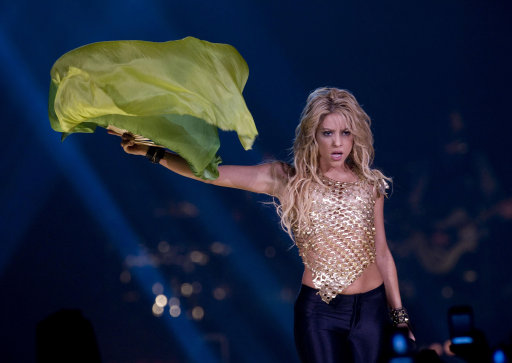
Fortunately, all that was blown away by her eventual entrance that was part-fairytale, part-diva, all magical. Borderline religious, in the way this tiny figure makes a serene procession through the crowd, singing the beautiful hymn-like Pienso En Ti, blessing many lucky fans with a handshake while others stretch out for the slightest touch.


All this in a voluminous gown pinker than anything ever worn by Barbie, then as she ascends to the stage, it’s whoosh – off with the gown – and the more familiar slinkier, streamlined version notches up the tempo and the temperature.

Exercising her constitutional right to bare midriff, she hits full rock-chick belly-dancer mode in chainmail crop-top and spray-on trousers. And there I’d been, afraid that the big freeze would prompt her to perform the whole show in parka and Ugg boots like some strange Eskimokira. I’m sure she’d have still been good, you know, but we’d have missed seeing those muscles in motion that are unique to this lady.

I swear I have never seen anyone move the way she does and if there is anyone who commands the stage and an audience better, then I’ve yet to see them. This is a woman who’s fully aware of her sex appeal and her charms, she’s mastered this particularly exotic body language and she knows how a few exquisitely pronounced phrases will drive a crowd wild. And yet she’s not cocky or aloof with it, there’s no sense of diva-ish distance. There’s great humour and warmth in her stage personality. She’s playful and she’s here to party.

“I’m here to give you pleasure,” she says. “Tonight, I’m all yours.”

It’s tough not to cheer at that, even when your wife is standing right next to you.

The beauty of Shakira is not merely skin deep though. And my wife wasn’t only present to keep an eye on me – not that she needed to – we were safely some distance back in the audience and anyway I would have been on my best behaviour even if I had been among the very lucky handful to be invited on stage for a dance and a hug (sigh) with the star. No, my wife is an admirer of Shakira herself and even she would agree that Shakira’s attractions extend beyond the physical.

Musically, she’s superbly talented, fearless, emotional and refreshingly quirky, offering a blend as unique as those muscles of hers. How many belly-dancing rock-chick pop princesses are there out there? Her voice ranges from sweet and soft to something powerful that seems to echo down from the Andes and she’s able to invest even the more straightforward poppish songs like She Wolf with so much of herself that there’s nothing else out there quite like her. I applaud the electronic experimentation behind the She Wolf album, but it’s not my favourite. Live, I’m glad to say, that She Wolf – the single – comes properly to life and Gypsy, the finest song on that album, provides for one of the (many) fine moments in the show.

The mix of numbers was inspired and as well as being a great recipe for a party, they really showed off the full range of what Shakira’s all about. There was a generous focus on older tracks – the storming, stomping Te Dejo Madrid, Ciega Sordomuda with its glorious Mexican fiesta-vibe, an innovative rockier arrangement of Whenever, Wherever - and songs from her latest album, Sale El Sol, including the beautiful title track and the pure party piece, Loca - which I think are far greater celebrations of her roots. Along the way she takes moments to tug at our heart strings with exquisite love songs like Underneath Your Clothes. Even better, the majority of songs are in Spanish which – coupled with that body language of hers – lend her music a richness that a number of her English-language tracks can’t quite equal.


And in case none of this appears to boast that ‘refreshing quirkiness’ of which I spoke, well, there is always the giant head that appears about halfway through the show to form a centrepiece to the stage set. More quintessentially Shakira though is the part where she dances horizontally. Lying flat out on stage, she has her drummer perform a kind of percussive CPR, her body responding to each and every beat until she rises in one graceful motion. It’s simultaneously comical, sexy and captivating.

Above all, she’s a dazzling entertainer and she puts on a real show.

At one point, at the climax of a number, she rips off one of those chainmail crop-tops. She’s wearing a bra underneath, I hasten to add, but it’s far less than anyone should be wearing in one of the coldest British winters on record.


Nobody minded (and for me the temptation to shout "More!" proved too much), not least because by this point the temperature in the O2 is positively tropical. Even when Waka Waka is performed under a shower of artificial snow, she has taken us on a journey through South America (including Hips Don’t Lie – far from it and they have a highly flexible vocabulary), by way of the Middle East (the thumpingly powerful Ojos Asi), and then on to South Africa. Never once have our spirits veered towards the Arctic and to be honest mine were buzzing nicely enough to keep me warm all the way back to our hotel and throughout the next day when meeting up with friends in the still-frosty streets of the capital.

Now if only I can figure out how to get Shakira fitted at home, that’ll be me warm and happy for the rest of the winter.

SAF

Thursday, December 09, 2010

Miranda Writes

You have the right to remain silent, so say the Miranda Rights. But there's one Miranda I'd particularly been looking forward to having as a guest on my blog and since she agreed to pop over here for an interview, what would be the point in her remaining silent? So, a big welcome to Miranda Dickinson, fantastically talented and pretty wonderful bestselling author and one of the true stars of HarperCollins' authonomy site back when I used to patrol that virtual beat.

Anything you say here will be taken down and used, not against you, but very much for you in a promotional capacity.


So, first of all, we're about a year on from Fairytale of New York. Is it all still a fairytale for you?

It is, in that I can walk into my favourite bookshop and see my book there. I will never get over the thrill of that. It’s very odd when something you’ve done for fun becomes the thing that pays your rent (or not, as the case may be…) because suddenly you don’t have the luxury of having a day off, or writing whenever the mood takes you. It always amuses me that, when I’m surviving on three hours sleep, writing like a madwoman every minute I get and panicking about impending deadlines, someone invariably comes up and says ‘Wow, you’ve got a dream come true, haven’t you?’ Living the dream, baby, living the dream… But when all’s said and done, it is a dream come true and an incredible honour to be able to write books that are read by people all over the world.

As far as I understand it, you initially landed a two-book deal with Fairytale. Did you have ideas in hand for the second book or was that something you had to come up with after the deal was signed?

It was a three-book deal, which scared the living daylights out of me because at the time HarperCollins first got in touch with me I only had two ideas! When I had the initial conversation with them, they asked me if I had any other ideas besides the one that eventually became Fairytale. After an embarrassingly tumbleweed moment when I mentioned my mystical wombat novel (it’s still on Authonomy and I think it’s really good, although perhaps not rom-commy enough for Avon!), I mentioned an idea I’d had where for most of the book the protagonist was locked in the middle cubicle of the ladies’ loos at a village hall after an almighty argument at a party. They loved that idea – and that’s what became Welcome to My World, my new novel.

This book concerns Harri and we leave Rosie behind, although I remember you saying that the story took place in the same fictional world and there may be references readers can pick up on. Was there ever a part of you that wanted to do a straightforward sequel to Fairytale or did you consider that story closed?

There are tiny links to Fairytale in that Rosie’s mum Rosemary is in the story and the action takes place in the small Black Country town where Rosie grew up before she moved to America. I like to sneak subtle links in as little rewards for people who’ve read Fairytale, but it’s not vital to have read that before reading this story. As for a sequel to Fairytale, I’ve been asked about that a lot, but to be honest I want to leave the characters where they were. I would only consider a sequel if I felt there was sufficient room for the characters to move their stories on; as it is I feel like I left them in a good place and I’m happy for them to work out their own futures without my intervention!

How was the writing process for your second novel compared to the first?

Very quick! It’s true what they say that you have your whole life to write your first novel and four months to write your second. In my case it was more like three months for the initial draft. The first four chapters were already written before Fairytale was ever spotted on Authonomy, so I had a bit of a head-start, but it was still a lot of work to get done – especially as I still work three days a week.

The main issue I faced was a sudden bout of nerves, which almost stymied me for quite some time. I think this was largely due to Fairytale’s stratospheric rise: within the first month, it had become a Sunday Times Top 10 Bestseller and by Christmas it had passed the 100,000 sales mark. I found the whole thing unbelievably intimidating and instead of enjoying the rollercoaster success ride I’d always dreamed about, I found myself terrified that I’d never be able to live up to the success of my first novel. The words ‘disappointing second novel’ hung over me like the Sword of Damocles and I battled with doubts throughout the whole year.

That said, I’m a big believer in the theory that the things in life that are worth something are the ones you have to fight the hardest for. Welcome to My World is a definite step up from Fairytale and I can see that I’ve learned a great deal from the experience of publishing my first novel. I think Welcome is more of a slow-burner success-wise than Fairytale and actually that’s come as a bit of a relief after all the hype and craziness last year. The point is, I know it’s a better novel and the reaction from reviewers has been a lot more positive – even those who haven’t liked the genre have said it’s well written.


What was the inspiration for Welcome To My World?

When I wrote Fairytale it was as an avid Armchair Traveller – and what interested me was the ambitions so many people hold dear yet never pursue. What stops us from following our dreams? Is it fear, circumstance or history? And how do we break out of that? So Harri, the main character, is completely in love with travel but has only experienced it though other people’s eyes. Worse still, she works as a travel agent in a town where most of the population isn’t bothered about seeing the world. I wanted to see what would happen to her when she met other people who had taken the leap of faith and what effect this would have on her own dreams.

Of course, these days, it's de rigeur to have a preview chapter of your next book included in any novel and I already notice a preview for your third book in the back of Welcome To My World. Does that pile on the pressure or do you see it as part of the ongoing dream?

It was actually a conscious decision of mine to include the first chapter of the next book in the back of each of my novels. This was mainly because they are written in very different styles, so I wanted people to get a taste of what to expect from the next story so it didn’t come as a shock! I want to take people with me on the literary journeys I create, so I think it’s really important to leave people wanting more!

How do you handle the publicity side of your career? It must be pretty hectic for a bestselling author. Would you prefer to shy away from all that and stick to the writing or do you relish that? How on earth do you balance the two - as well as your music career?

I don’t think you can exist in splendid isolation as an author any more, particularly if you write romantic comedies or chick-lit like I do. A crucial part of encouraging people to stick with your writing is to be very open and accessible and now, with social media so much a part of everyone’s lives, this is even more important. I actually love it, if I’m honest. I’m a chatterbox and very gregarious at heart, so chatting relentlessly about writing, life and just about anything else that blows into my mind comes incredibly naturally to me (as my lengthy answers to your questions so far will attest!) But I know I’m fortunate in that respect and that many authors struggle with having to be publicly on show so much. I strongly believe in engaging with the wonderful people who choose to pick up my book when there are so many other shiny titles in the bookshop. It’s a responsibility I take very seriously.

Now, I've read Fairytale and enjoyed that very much. It struck me as very readily translatable into a Hollywood Rom-com. Is that something you'd like to see and if so who would you cast as the main characters?

Absolutely! I write very visually, in short scenes like a film, so it would be fantastic to see it realized on the big screen. As for casting, probably someone like Anne Hathaway or Carey Mulligan as Rosie (good English accent would be crucial), Patrick Dempsey or Justin Bartha (Failure to Launch, The Hangover) as Ed, Alison Janney (The West Wing) or Wendie Malick (Just Shoot Me) as Celia, Zooey Deschanel (500 Days of Summer) as Marnie, Matthew McConaughey as Nate and Jake Gyllenhaal as David.

You wrote about New York for Fairytale and now in Welcome we travel to Venice. To my poorly informed perspective, New York always conjures cop shows and the like, but you painted it with such warmth in Fairytale. While Venice is definitely romantic territory. So first of all, have you been to Venice? And whether you have or not, how do you go about capturing the character of a place for your novels?

Perhaps unsurprisingly, (after writing Fairytale about a place I’ve yet to visit) I’ve never been to Venice! I think the key to making the setting realistic is to really research it. It’s important to get a sense of a place, not just the facts that you’d glean from a travel book. I talk to people who’ve been there, asking them for details like the smells, sounds and feelings they got from the city, and read anything set there. I think it’s an art to get the balance between facts and feelings right: hopefully, if you succeed, you give the reader enough detail to provide a framework and then their imagination will fill in the gaps.

Welcome To My World seems a very inviting title. So go ahead and invite us into Harriet (Harri) Langton's world. What can readers expect to find there?

Harri’s world is one of hopes and dreams yet to be fulfilled; love and friendship from those around her; and a longing for the family she has lost. When she is talked into helping her best friend Alex’s mother Viv into finding him a suitable date, Harri unwittingly sets a chain of events into action that end with her locked in the middle cubicle of the Ladies’ loo at Stone Yardley Village Hall after all hell breaks loose at an engagement party. Find out what causes it – and, more importantly, what lies in wait for her when she finally emerges from the grey-green vinyl sanctuary to finally face the music…


Thanks so much for having me!

M xx


My pleasure!

Readers should know that Welcome To My World (which I'm currently reading!) is available from Amazon (both paperback and Kindle versions) and all good bookstores. As is her first novel, Fairytale Of New York. Miranda herself can be found at her website, where you'll also find details of a competition to win a trip to Venice. And be sure to check out her blog, Coffee & Roses.

SAF